

What Does UL Listed Mean for a Food Processing Electrical Enclosure?
UL Listing tells a buyer that a product has been evaluated under an applicable UL certification program. For electrical enclosures, UL 50 et UL 50E address non-environmental and environmental enclosure considerations, including Type ratings, while UL 508A is the Standard for Industrial Control Panels.
That distinction matters when buying a complete food processing control cabinet. A UL Listed empty enclosure does not automatically make the finished assembly a UL 508A Listed industrial control panel. A finished panel has additional requirements involving component use, construction, ratings, markings, and other panel-level considerations.
UL Type 4X vs NEMA Type 4X
The terms are closely related, but they should not be treated as identical certification claims.
NEMA 250 defines enclosure Type requirements, but NEMA does not certify, test, or inspect individual products. Manufacturers or other parties are responsible for their statements of conformity to NEMA requirements, while UL provides third-party certification to applicable enclosure standards. A NEMA Type 4X claim and a UL-certified Type 4X rating therefore should not be treated as the same certification claim.
Most importantly, UL Listed does not automatically mean food-grade, hygienic, FDA approved, or suitable for direct food contact. Environmental certification and sanitary design address different questions and should be evaluated separately.

Choosing the Right Enclosure Type by Food Plant Zone
The best starting question is not, “What enclosure is best for the food industry?” It is: What will actually reach the enclosure where it is installed?
FDA current good manufacturing practice requirements require non-food-contact equipment surfaces to be cleaned as frequently as necessary to protect against allergen cross-contact and contamination. The location and exposure of an electrical enclosure therefore matter.
| Plant Zone | Typical Exposure | Typical Starting Point | Main Buyer Concern |
|---|---|---|---|
| Electrical or control room | Dust, indoor contamination, incidental dripping | Tapez 12 | Indoor environmental protection |
| Dry packaging area | Dust, occasional moisture, routine cleaning | Type 12 or project-specific | Protection and cleanability |
| Wet processing area | Hose-directed water, humidity, condensation | Tapez 4 | Infiltration d'eau |
| Corrosive washdown area | Water plus corrosive cleaning conditions | Tapez 4X | Water and corrosion |
| Severe sanitation zone | High-pressure or high-temperature cleaning | Type 4X plus separately verified washdown/IP performance where required | Actual cleaning conditions |
Use the table as a starting point rather than a substitute for the project specification or authority having jurisdiction. Type 4X is appropriate where both water exposure and corrosion resistance matter, but it should not be specified plant-wide when dry areas face much lower environmental exposure.
What About IP66 or IP69?
UL/NEMA Type ratings and IEC Indice de protection IP vs indice de protection UL systems are separate classification methods. They should not be treated as direct one-to-one equivalents. UL certification programs can cover both enclosure Type ratings and IP ratings, but each claim needs to be verified independently.
This distinction is especially important when selecting boîtiers électriques lavables. A Type 4X rating should not be treated as automatic proof of IP69 performance.
Instead of choosing the largest rating number available, document the actual cleaning conditions: water pressure, temperature, spray conditions, chemicals, exposure time, and cleaning frequency. The enclosure specification can then be matched to the sanitation process.

Hygienic Design, Stainless Steel, and Installation
Keeping water out of an enclosure and making its exterior easy to clean are different engineering goals.
3-A hygienic-design guidance for nonproduct contact surfaces emphasizes cleanability and avoiding construction details that can retain soil or liquid. Its guidance on electrical control boxes specifically identifies difficult-to-clean hinges and mounting arrangements as potential sanitation concerns.
What Makes an Electrical Enclosure Easier to Clean?
Useful hygienic enclosure features include sloped or self-draining upper surfaces, smooth exterior construction, cleanly finished welded seams, minimal ledges, crevices and exposed threads, cleanable hinges and latches, accessible gaskets, and mounting that leaves adequate sanitation access. These features improve cleanability; they are not a universal FDA prescription for one specific enclosure shape.
Most control cabinets are non-food-contact equipment, so requirements written specifically for food-contact surfaces should not automatically be applied to them. However, FDA requires non-food-contact equipment surfaces to be cleaned as frequently as necessary to protect against allergen cross-contact and contamination, making cleanability and access relevant to enclosure design and installation.
Some food-equipment projects may also specify NSF sanitation certification. NSF requirements address areas such as hygienic design, materials, construction, and cleanability separately from UL electrical and enclosure certification, so buyers should confirm whether NSF certification is actually required by the equipment specification or customer.
304 vs 316/316L Stainless Steel
Boîtiers en acier inoxydable 304 vs 316 differ in how they perform under corrosion exposure. 304 stainless steel is widely used in food and beverage equipment and can be suitable where corrosion exposure is moderate. 316 and 316L stainless steels contain molybdenum and are better candidates when greater corrosion resistance is required, including applications involving chloride-containing environments or more aggressive process conditions.
Do not treat these grades as a simple ladder: 304 → 316 → 316L, where each step automatically means greater corrosion resistance.
The “L” in 316L identifies a lower-carbon grade. Lower carbon content reduces carbide precipitation caused by heat input and improves resistance to intergranular corrosion after welding; it does not simply make 316L more corrosion resistant than 316 under every service condition.
A better purchasing rule is: Select stainless steel from the sanitation protocol, not from the industry name.
Consider the cleaner and sanitizer chemistry, concentration, chloride exposure, pH, temperature, contact time, and cleaning frequency. Gaskets and other nonmetallic materials should also be checked for compatibility with the chemicals and temperatures they will encounter.
Hygienic Installation Matters Too
A well-designed enclosure can still create sanitation problems if it is mounted badly.
3-A guidance on electrical control boxes recommends stand-offs that provide at least one inch of clearance between the box and mounting surface so the area can be inspected and properly cleaned. It also warns against continuous piano-type hinges where inaccessible crevices can retain contamination.
In practice, leave enough clearance to inspect and clean behind and around the cabinet. Avoid brackets, cable-entry locations, and wall gaps that trap water or residue, and avoid positioning the enclosure where contamination could drain or fall toward exposed product.
A hygienic enclosure loses much of its value if the installation creates new dirt traps.

How to Specify and Verify a UL Listed Food Processing Enclosure
A useful RFQ should go beyond phrases such as “food-grade stainless steel cabinet” or “NEMA 4X box.” It should define the conditions the enclosure must withstand and the finished configuration the supplier is expected to provide.
1. Define the Environment Before the Product
Start with the installation zone, ambient conditions, washdown method, humidity or condensation risk, sanitation chemistry, and corrosion exposure. This avoids choosing Type 4X or a stainless grade before the actual application is understood.
2. Build a Clear RFQ
A practical enclosure specification should identify:
- enclosure dimensions and mounting arrangement
- required UL Type and any additional IP rating
- stainless steel grade
- door, hinge, latch, gasket, and hygienic-design requirements
- cable entries, conduit openings, HMIs, pushbuttons, windows, and other cutouts
- thermal-management requirements
- required certification and production documentation
This gives the manufacturer enough information to evaluate the actual design rather than quote a generic “food-grade enclosure.”
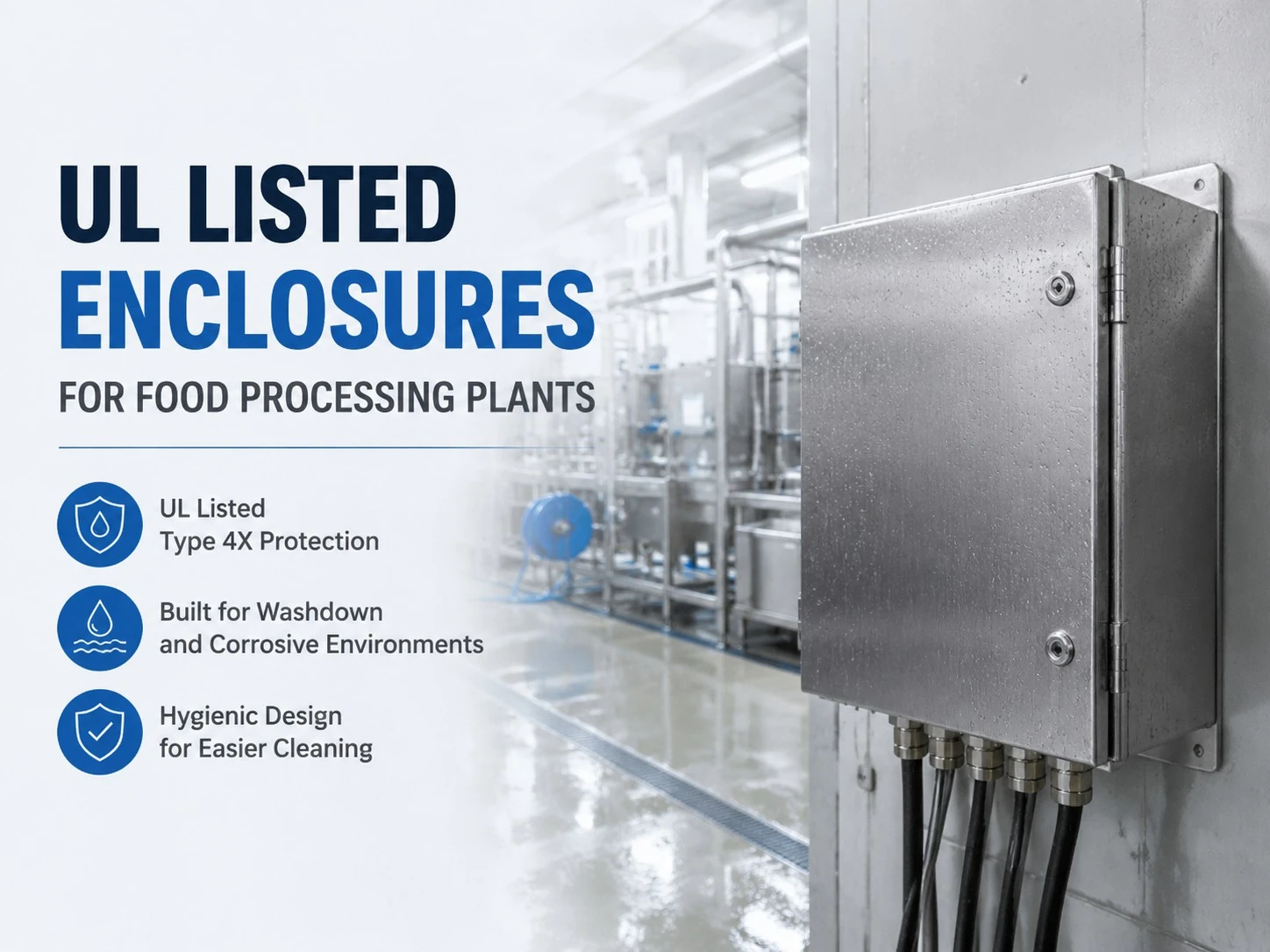
Buyers who need a configurable starting point can also review Eabel’s UL Listed enclosure options, including Type 4X configurations and choices for material, dimensions, mounting, doors, accessories, and assembly. The final certification scope should still be confirmed against the exact configuration being ordered.
3. Check Heat Load Before Finalizing the Cabinet
A sealed washdown enclosure can make heat removal more difficult. PLCs, drives, power supplies, transformers, and other devices can raise the internal temperature even when there is enough physical space for the equipment.
The answer is not automatically to cut ventilation openings or install an ordinary fan. Environmental-rated accessories such as air conditioners, heat exchangers, fan assemblies, windows, hole plugs, cable sealing devices, hinges, and latches can be evaluated for specific Type or IP applications. Their suitability needs to match the required rating of the finished design.

4. Finalize Cutouts and Accessories Before Production
Custom openings do not automatically cancel UL certification, but neither should buyers assume that the rating of an untouched empty enclosure automatically covers every modified configuration.
Windows, cable sealing devices, cooling equipment, handles, hinges, latches, and other enclosure accessories can have specific ratings and conditions governing their use. The practical rule is to confirm how the final configuration fits within the applicable certification scope after the design is finalized.
5. Know Whether You Are Buying an Enclosure or a Finished Control Panel
If you are buying an empty enclosure, verify its certification, Type rating, construction, and material.
If you are buying a finished industrial control panel, verify the certification and ratings of the completed panel as well. UL 508A addresses the finished industrial control panel, and its requirements extend beyond the outer enclosure. Short-circuit current rating is also a panel-level consideration, with UL 508A Supplement SB providing an accepted method for determining SCCR.
A UL Listed Type 4X enclosure is therefore only one part of a finished UL 508A panel specification.
6. Verify the UL Record, Not Just the Logo
Do not approve a product solely because a UL badge appears on a supplier website, brochure, or quotation.
UL Product iQ is UL Solutions’ database for verifying certification information. It can be searched using information such as company name, model number, file number, Category Control Number (CCN), or other product identifiers.
Also be aware that current UL Certification Marks do not always use the traditional word “Listed.” Enhanced UL Certification Marks may use “Certified,” and their identifiers can be used to trace the applicable certification information.
Before releasing an order, match the quoted product against the manufacturer, model or series, UL file or identifier, applicable Type rating, and certification scope. For a custom enclosure, ask the supplier to explain how the final configuration is covered.
7. Protect the Rating After Installation
A correctly specified enclosure can still perform poorly after field modification or poor maintenance.
Unplanned holes, accessories with inadequate environmental ratings, damaged gaskets, loose latches, added ventilation openings, incompatible cleaners, and poorly positioned penetrations can all undermine the intended protection or sanitation performance. Condensation should also be considered in refrigerated areas and installations with significant temperature cycling.
Inspection should therefore cover seals, latches, penetrations, corrosion, drainage, mounting clearances, and cleaning access throughout the enclosure’s service life.
When Type 4X Is Not Enough
Type 4X addresses environmental enclosure protection. It does not replace a hazardous-location evaluation.
Food plants may handle combustible powders such as flour, sugar, starch, and other organic dusts. If these materials create a hazardous classified location, OSHA hazardous-location requirements require electrical equipment and wiring to be intrinsically safe, approved for the location, or otherwise safe for that location.
A standard Type 4X washdown enclosure therefore should not be assumed to satisfy hazardous-location requirements. Where combustible dust may be present, qualified electrical and safety professionals should determine the area classification and specify suitable equipment.
FAQs About UL Listed Electrical Enclosures for Food Processing Plants
Conclusion

The best UL Listed electrical enclosure for a food processing plant is not simply the cabinet with the highest Type rating or the most expensive stainless steel. A strong specification combines verified certification, the correct environmental rating, actual sanitation conditions, suitable materials, hygienic construction, controlled customization, and cleanable installation.
Type 4X is an excellent starting point for many wet and corrosive processing areas, but dry rooms, severe sanitation zones, and combustible-dust locations can require different decisions. Selecting from the real installation conditions makes the enclosure easier to specify, clean, maintain, and verify.
If you are sourcing UL Listed electrical enclosures for a new food processing line, replacing corroded cabinets, or developing a custom control enclosure, contactez notre équipe with your dimensions, installation environment, washdown conditions, material requirements, drawings, cutouts, and required certifications. We can help review the specification and develop an enclosure configuration that better matches your processing environment and project requirements.
Lectures connexes
Industrial Control Panel Enclosure Buying Guide
Nettoyage et entretien des boîtiers électriques : Guide des bonnes pratiques
How to Prevent Rust in Electrical Enclosures
Indices de protection NEMA pour les boîtiers : Guide complet de l’acheteur
Boîtiers de panneau de commande personnalisés et standards : une comparaison détaillée
Tailles des boîtiers électriques : guide complet pour choisir le bon modèle



 FR
FR  EN
EN  ES
ES  AR
AR  JA
JA  KO
KO  RU
RU  DE
DE  PT
PT  IT
IT  ZH
ZH  TH
TH  VI
VI  HI
HI  MS
MS 