

Find the Main Causes of Enclosure Corrosion

Electrical enclosure rust rarely begins across a large, undamaged panel. It usually starts at a small weak point where water, salt, chemicals, or damaged coating reach the base metal.
Rust specifically affects iron and steel. Stainless steel and aluminum may not develop the same red-brown rust, but they can still suffer pitting, staining, galvanic corrosion, or chemical attack.
External Moisture, Salt, and Chemicals
Outdoor electrical enclosure rust may be caused by rain, snow, humidity, UV exposure, industrial pollution, or repeated temperature changes.
Water alone is not always the greatest threat. Salt deposits and chemical residues can hold moisture against the surface long after visible water has disappeared.
Coastal electrical enclosures face airborne chlorides even when they are not near direct seawater spray. Salt often collects around seams, hardware, damaged coatings, and horizontal surfaces.
Washdown areas create another risk. Food, beverage, pharmaceutical, and wastewater plants may use hot water, detergents, disinfectants, acids, or alkaline cleaners.
A material that performs well in clean water may fail under repeated chemical cleaning. Confirm the exact chemical, concentration, temperature, pressure, and exposure time before selecting the enclosure.
General claims such as “chemical-resistant electrical enclosure” offer limited value without compatibility data for your actual operating conditions.
Condensation and Common Failure Points
Moist air can enter when the door is opened, through cable entries, or along conduit. It may also be trapped inside during assembly, shipping, or installation.
Condensation forms when an enclosure surface falls below the air’s dew point. Equipment shutdowns, nighttime cooling, and rapid weather changes can increase this risk.
A sealed cabinet can therefore remain dry on the outside while moisture develops internally.
Corrosion often starts at scratches, welds, sharp edges, door seams, gasket channels, cable holes, hinges, latches, threads, and grounding points.
Water may also collect where the enclosure design, mounting direction, or installation prevents proper drainage.
Contact between dissimilar metals creates an additional risk. In the presence of moisture, the metals may form a galvanic cell and one material can corrode faster.

Choose the Right Corrosion-Resistant Material
No enclosure material is suitable for every environment. Start with the site conditions, then compare corrosion resistance, strength, cost, heat dissipation, weight, and maintenance needs.
| environnement d'exploitation | Main corrosion risk | Typical starting option |
|---|---|---|
| Clean indoor area | Occasional humidity | Powder-coated mild steel |
| Humid industrial facility | Condensation and residues | Coated steel or 304 stainless steel |
| General outdoor location | Rain, UV, and temperature cycling | Coated steel, aluminum, or stainless steel |
| Food or beverage washdown | Water and cleaning chemicals | Acier inoxydable 304 ou 316 |
| emplacement côtier ou marin | Salt and chloride deposits | 316 stainless steel or suitable non-metallic material |
| Chemical or wastewater plant | Corrosive gases and liquids | Verified stainless steel, fiberglass, or polymer |
| Electrically insulated application | Corrosion and conductivity | Fibre de verre ou polycarbonate |
These options are starting points, not universal specifications.
Final selection should consider chemical type, concentration, temperature, chloride level, UV exposure, cleaning method, impact risk, and expected service life.
If your site requires a specific material, size, rating, or sealing layout, a standard enclosure may not cover every risk. You can review Eabel’s electrical enclosure options as a starting point, then confirm the final design against the actual corrosion, temperature, and installation conditions.

Coated and Galvanized Steel
A powder-coated steel enclosure offers good strength and an economical initial cost. It can perform well in clean indoor areas and moderate industrial environments.
Its performance depends heavily on surface preparation and complete coating coverage.
Once the coating is scratched or damaged, exposed steel can rust. Edges, welds, threads, bends, and field-cut openings often have less protection than flat panels.
Galvanized steel uses a zinc layer to protect the steel beneath it. The zinc can provide sacrificial protection, but welds, cut edges, and drilled holes still require proper treatment.
Do not select coated steel only because it has the lowest quotation. Compare the likely repair, maintenance, and replacement costs under the real site conditions.
Boîtiers en acier inoxydable 304 et 316
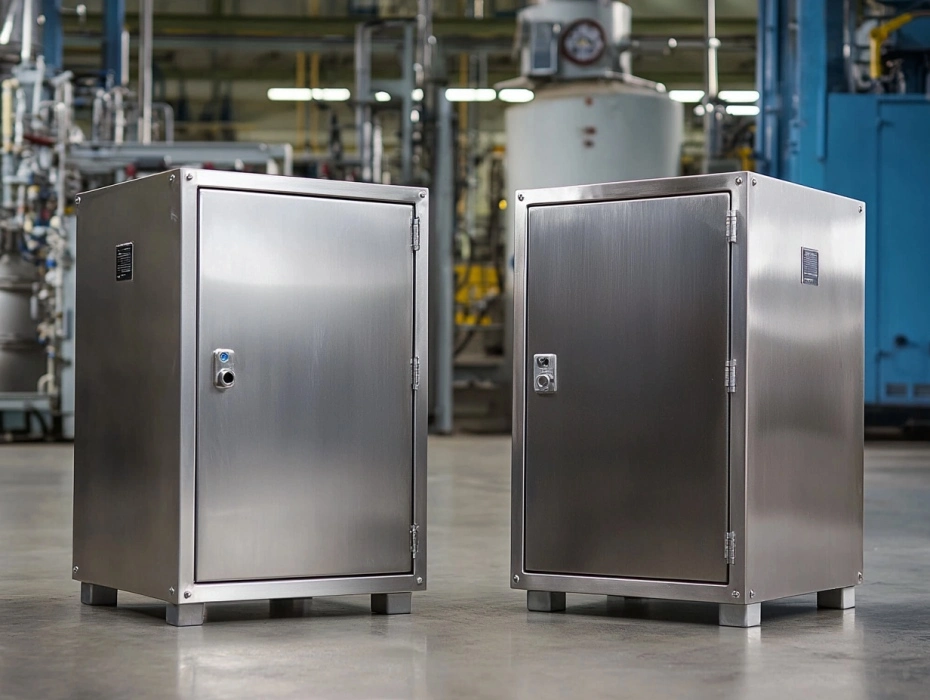
A 304 stainless steel electrical enclosure provides good general corrosion resistance. It is widely used in industrial, outdoor, food-processing, and moderate washdown applications.
Type 316 typically contains molybdenum. This improves resistance to chloride pitting compared with Type 304.
For this reason, understanding the differences between Boîtiers en acier inoxydable 304 et 316 is important when specifying cabinets for coastal, marine, wastewater, or chloride-rich environments.
That does not mean 316 stainless steel is corrosion-proof. High temperatures, concentrated chlorides, harsh chemicals, or trapped deposits can still cause pitting and crevice corrosion.
Stainless steel grade is also only part of the specification.
Carbon-steel dust, shared grinding tools, embedded iron particles, and untreated welding heat tint can reduce local corrosion resistance.
For more detail, review the British Stainless Steel Association’s guidance on post-weld cleaning and finishing of stainless steel.
Before ordering, ask how the stainless steel is cut, welded, cleaned, and finished. Confirm whether weld cleaning, pickling, or passivation is required for your project.
Compatible stainless steel fasteners and hardware are also important. A high-grade enclosure body offers limited value if the hinges, latches, or bolts corrode first.
Aluminum, Fiberglass, and Polycarbonate
Aluminum is lightweight, easy to machine, and naturally forms a protective oxide layer. It also offers useful heat dissipation.
It can still suffer chemical or galvanic corrosion. Strong acids, alkaline cleaners, chlorides, and contact with incompatible metals require careful review.
Fiberglass and polycarbonate do not develop iron rust. They can be useful in wet, corrosive, or electrically insulated applications.
A non-metallic enclosure is not automatically suitable for every harsh location.
Check its UV stability, impact strength, temperature range, flame rating, chemical compatibility, heat dissipation, and dimensional stability.
Polymer enclosures also provide less natural electromagnetic shielding than metal cabinets.
Internal mounting plates, fasteners, cable glands, and electrical parts may still corrode. A non-metallic body does not remove the need for complete-system protection.

Check Coatings and Manufacturing Quality
Corrosion resistance begins in manufacturing. A suitable material can still fail if the surface preparation, coating application, welding, sealing, or hardware selection is poor.
Surface Preparation and Coating Performance
Before coating, the metal must be free from oil, dust, rust, scale, fingerprints, and welding residue.
Sharp edges and rough welds should be smoothed. These areas often receive a thinner coating layer and may become the first points of failure.
Depending on the material and application, preparation may include degreasing, cleaning, phosphating, conversion treatment, rust removal, and controlled drying.
A premium coating cannot compensate for a contaminated or poorly prepared surface.
“Powder coated” is not a complete specification. Before you choose the right electrical enclosure coating, confirm the pretreatment, coating type, thickness, curing process, and expected exposure conditions.
The complete protection system may include powder coating, E-coating, epoxy primer, polyurethane topcoat, galvanizing, anodizing, or a duplex system.
Before production, confirm the pretreatment method, coating type, dry-film thickness, adhesion, cure conditions, UV resistance, and chemical performance.
You should also ask for an approved touch-up method. This is important if the coating is damaged during transport, installation, or field modification.
Le ISO 12944 corrosivity categories can support coating selection by classifying common atmospheric environments, although they do not replace electrical enclosure product requirements.
Welds, Edges, Gaskets, and Hardware
Edges, corners, folds, welds, threads, and cutouts deserve more attention than large flat surfaces.
Coating may become thinner at sharp edges. Welding can also damage nearby protective layers or leave rough areas that trap chemicals and salt.
For stainless steel, heat tint and free-iron contamination should be removed where required. The correct finishing method depends on the material, environment, and project specification.
Gaskets must remain flexible under the expected temperature, UV exposure, oils, chemicals, and cleaning products.
A gasket that cracks, swells, hardens, or loses compression may allow water and contaminants to enter.
Hinges, latches, brackets, fasteners, and gland locknuts should be compatible with the enclosure body and surrounding environment.
Where dissimilar metals cannot be avoided, suitable isolation may reduce galvanic corrosion. Any isolation method must still maintain required grounding and bonding.
Drainage paths should be included in the approved enclosure design. Do not assume that an unplanned hole will improve protection.

Prevent Condensation and Storage Damage
Moisture inside electrical enclosures can damage terminals, grounding points, mounting rails, conductors, and electronic equipment.
For many sites, controlling condensation is more important than adding another coating layer.
Control Dew-Point Risk
Sealing reduces external air and water movement, but it does not remove water vapor already inside.
The roof, door, or sidewall may become colder than the internal air. Water can form on these surfaces even when the measured humidity does not appear extreme.
Shutdown periods often create the greatest risk. When equipment stops producing heat, internal surfaces cool while humid air remains inside.
Relative humidity alone does not fully describe condensation risk.
A more useful engineering measure is the dew-point margin. This is the difference between the coldest internal surface and the internal air’s dew point.
A smaller margin means a higher risk of condensation.
Because sealing alone cannot remove trapped water vapor, you may also need heaters, hygrostats, vents, or closed-loop cooling to prevent condensation in electrical enclosures.
Depending on the application, moisture-control options include anti-condensation heaters, hygrostats, thermostats, internal fans, pressure vents, heat exchangers, and closed-loop air conditioners.
Open filter fans may introduce humid, salty, dusty, or chemically contaminated air. They are not ideal for every harsh environment.
An oversized cooling system may short-cycle and create unstable temperatures. Confirm the heat load, control method, and condensation risk before sizing the unit.
Desiccants and vapor corrosion inhibitors can provide supplementary protection.
Before using a VCI, confirm compatibility with electrical contacts, plastics, sensors, ventilation, and operating temperature. Check the required enclosure volume and replacement interval.
For remote or high-value equipment, temperature and humidity sensors can provide an early warning before visible water or rust appears.

Protect Equipment During Shipping and Storage
Corrosion can begin before the enclosure enters service.
During shipping, protect the coating from scratches and use suitable moisture barriers where required. Long sea routes may also require desiccants and humidity indicators.
After delivery, inspect the packaging, coating, hardware, seals, and interior for water marks or damage.
Do not open cold equipment immediately in a warm, humid area. Allow it to acclimate according to the supplier’s instructions.
During storage, keep the enclosure clean, dry, sealed, and protected from leaking roofs, standing water, chemical vapors, and rapid temperature changes.
An outdoor rating does not mean the equipment can remain indefinitely outside in transport packaging.
If commissioning is delayed, approved anti-condensation heaters may be required. Inspect the enclosure again before energizing the equipment.
Protect the Enclosure During Installation
A well-made enclosure can lose much of its corrosion resistance during field installation.
Poor mounting, unsuitable fittings, unprotected drilling, and incorrect grounding methods may create new water and corrosion paths.
Choose the Site and Seal Every Entry
Where possible, avoid locations beneath leaking pipes, roof drainage, cooling-tower spray, chemical exhaust, or direct washdown.
The enclosure should also remain accessible for cleaning, inspection, and maintenance.
Every cable or conduit opening requires suitable fittings. Use glands, hubs, plugs, locknuts, and sealing washers that match the required rating and environment.
Unused openings should be closed with approved plugs.
Avoid unnecessary top entries. Water can collect around the fitting or travel through conduit into the enclosure.
A correctly rated empty box does not guarantee that the completed installation will have the same protection level.
The final assembly may be limited by its lowest-rated gland, vent, window, drain, cooling unit, or other accessory.

Control Field Modifications and Grounding Points
Field drilling and cutting should follow the enclosure manufacturer’s instructions.
After making an opening, remove all metal chips, deburr the edge, clean the exposed surface, and apply the approved repair treatment.
Install an accessory with the correct rating and material. Then check the door alignment, gasket compression, and surrounding coating.
Metal chips must not remain inside the cabinet. They may damage components, create electrical risks, contaminate stainless steel, or become corrosion points.
Do not drill an additional drain hole without approval. It may reduce the IP rating, NEMA Type, or third-party certification status.
Use manufacturer-approved drains, drain vents, or designed drainage features.
Grounding and bonding points require reliable metal-to-metal contact. The surrounding exposed area may corrode if unsuitable hardware or assembly methods are used.
Follow the approved grounding procedure and keep the connection accessible for later inspection.
Compare NEMA 4X, IP66, and Test Evidence
IP and NEMA ratings provide useful information, but they do not answer every corrosion question.
Le official NEMA enclosure Type definitions distinguish Type 4 from Type 4X by adding a defined level of corrosion protection.
| Notation | Main protection | Corrosion coverage | Important limitation |
|---|---|---|---|
| NEMA Type 4 | Dust, rain, splash, and hose-directed water | Does not include the added 4X corrosion requirement | Does not solve every chemical or condensation risk |
| NEMA Type 4X | Type 4 protection plus defined corrosion protection | Yes, within the standard’s scope | Material and chemical compatibility still matter |
| IP66 | Dust-tight and protected against powerful water jets | Not independently evaluated by the IP code | Does not prove salt or chemical resistance |
NEMA develops enclosure standards but does not certify individual products.
Use accurate terms such as NEMA Type 4X, tested to NEMA 250, UL Listed Type 4X, or CSA Certified for a specified enclosure Type.
Avoid claims such as “NEMA certified” unless a separate certification body and exact certification are clearly identified.
Sous IEC 60529 IP ratings, IP66 addresses dust ingress and powerful water jets. The code does not independently prove resistance to salt, chemicals, or long-term corrosion.
Your project may require both an ingress rating and a separate corrosion-performance specification.

Check the Complete Assembly
A report for an empty enclosure does not automatically cover the finished cabinet.
Review the cable glands, hubs, pushbuttons, HMI windows, viewing panels, vents, drain fittings, cooling systems, door hardware, and customer-installed accessories.
Ask whether the tested configuration matches the final production design.
A small change in the window, gland, gasket, or cooling unit may affect the completed enclosure’s protection.
Read Salt-Spray Test Reports Correctly
Le ASTM B117 salt spray practice defines the chamber conditions and test procedure, but it does not prescribe one universal exposure period or interpretation for every product.
Salt-spray testing can help compare materials, pretreatments, and coating systems under controlled conditions.
It should not be used as a simple prediction of service life.
For example, 1,000 hours in a salt-spray chamber does not automatically equal a fixed number of outdoor years.
When reviewing an electrical enclosure salt spray test, confirm the test standard, sample type, base material, pretreatment, coating thickness, test duration, and failure criteria.
Ask whether the sample was scratched before testing and whether the report measured red rust, blistering, adhesion loss, or corrosion creep.
A flat laboratory panel may not represent the edges, welds, hinges, cutouts, and fasteners of a complete enclosure.
The test report should also match the current production coating system. A report from a different factory process, material grade, or coating supplier may not support your order.
Use the latest applicable test standard or specify the standard without an outdated revision year unless the project requires a particular edition.

Inspect, Repair, or Replace the Enclosure
Electrical enclosure maintenance should be based on risk, not one fixed inspection interval.
Consider the site environment, previous corrosion history, enclosure material, coating condition, equipment value, and consequences of failure.
Inspect the enclosure after flooding, severe storms, chemical leaks, aggressive washdown, drilling, gasket replacement, cooling-system work, or extended storage.
Early Warning Signs
Look for rust stains, blistered paint, exposed steel, pitting, white deposits on aluminum, water droplets, standing water, loose glands, or damaged gaskets.
Also inspect hinges, fasteners, grounding points, door seams, terminals, and conductor connections.
Salt, chemical residue, grease, and dust should be removed before they trap moisture or damage the finish.
Use cleaners that are compatible with the enclosure body, coating, gasket, labels, and electrical parts.
Abrasive cleaning may remove protective layers and create new corrosion points.
When Repair Is No Longer Enough
Minor surface corrosion may be repairable when the metal remains structurally sound and the moisture source can be corrected.
The damaged finish must be removed and restored with a compatible system. Gaskets, hardware, or glands may also need replacement.
Replacement or engineering review is more appropriate when the metal is perforated, the structure is weakened, or the door no longer seals correctly.
You should also consider replacement if grounding points are badly degraded, water repeatedly enters, or the original rating cannot be restored.
Extensive internal corrosion may mean that both the enclosure and electrical components require assessment.
De-energize the equipment before inspection or repair. Qualified personnel should follow the applicable lockout and electrical safety procedures.

Electrical Enclosure Rust Prevention Checklist
Before requesting a quotation, confirm:
- Installation location and mounting position
- Temperature and humidity range
- Coastal salt or chloride exposure
- Chemicals, concentration, and temperature
- Washdown pressure and cleaning agents
- Required enclosure material and grade
- Pretreatment and coating specification
- Gasket, hinge, latch, and fastener materials
- Required IP rating or NEMA Type
- Condensation-control method
- Corrosion-test standard and acceptance criteria
- Shipping, storage, maintenance, and field-repair instructions
The lowest enclosure price may not produce the lowest project cost.
An unsuitable material, damaged coating, weak seal, or uncontrolled moisture problem can lead to repairs, component damage, production downtime, and early replacement.
A well-specified corrosion-resistant electrical enclosure may cost more initially, but it can provide more stable protection over the full service life.

FAQs About Electrical Enclosure Rust Prevention
Conclusion

Preventing electrical enclosure rust requires more than stainless steel, powder coating, or a high IP rating. Material, surface treatment, seals, accessories, condensation control, installation, and maintenance must work together.
Share your enclosure dimensions, installation environment, required IP or NEMA rating, temperature range, and chemical exposure with Eabel. Our team can help you select a suitable material, coating, sealing system, and condensation-control solution.
Lectures connexes
Nettoyage et entretien des boîtiers électriques : Guide des bonnes pratiques
Climate Effects on Electrical Enclosures
How to Seal an Electrical Enclosure: IP Guide
Fiberglass vs Stainless Steel Enclosures Guide



 FR
FR  EN
EN  ES
ES  AR
AR  JA
JA  KO
KO  RU
RU  DE
DE  PT
PT  IT
IT  ZH
ZH  TH
TH  VI
VI  HI
HI  MS
MS 