

UL 891 vs UL 1558 at a Glance

These standards identify different equipment categories, not two quality grades. The useful question is how the assembly must perform during normal operation, faults, and maintenance.
UL 891 scope: The current UL 891 standard applies to dead-front switchboards rated 1,000 V or less. Its scope reaches 200,000 A rms symmetrical available fault current, but each assembly must carry its own marked rating. The standard does not cover switchboards with short-time current ratings.
The March 2025 revision added or revised requirements for multiple-source switchboards, forced-air cooling, emergency circuits, and service equipment. That matters because a UL 891 switchboard should no longer be dismissed as an under-600 V, single-source product based on older comparison pages.
UL 1558 scope: The active UL 1558 standard covers metal-enclosed low-voltage power circuit breaker switchgear nominally rated 1,000 V AC or less. Its sixth edition was published in April 2025, and the June 2026 revision added requirements for multiple-source switchgear.
UL 1558 supplements IEEE C37.20.1 and ANSI C37.51. These assemblies commonly use UL 1066 low-voltage power circuit breakers, but buyers must verify the exact current, duration, breaker arrangement, and complete-assembly short-time rating.
| Comparison factor | UL 891 switchboard | UL 1558 switchgear |
|---|---|---|
| Equipment category | Dead-front switchboard | Metal-enclosed LV power circuit breaker switchgear |
| Common protective devices | UL 489 molded-case or insulated-case breakers; UL 98 switches with UL 248 fuses | UL 1066 low-voltage power circuit breakers |
| Short-time current rating | Not covered by UL 891 | Available in evaluated configurations |
| Selective coordination | Achievable in suitable systems | Often offers more setting and delay flexibility |
| Device mounting | Group-mounted or individually mounted | Commonly individually mounted |
| Access | Commonly front-access | Front- or rear-access, depending on design |
| Maintenance | Compact, with device-dependent service options | More service-focused in many designs |
| Footprint | Usually smaller | Usually larger |
| Arc-resistant construction | Not established by the UL 891 label | Optional; must be separately specified and evaluated |
| Typical fit | Conventional commercial or industrial distribution | Complex, high-duty, or uptime-sensitive distribution |
Use the table for screening only; submitted drawings and ratings control the final choice. If panelboards or industrial control panels are also in the bid, first separate the product categories with this UL 508A vs UL 67 vs UL 891 comparison.
Fault Ratings and Selective Coordination
Fault performance is the main technical difference, yet the common “3 cycles versus 30 cycles” shortcut leaves out current magnitude, breaker behavior, the tested assembly, and the meaning of each rating.
kAIC, SCCR, and Short-Time Current Rating
Interrupting rating, commonly expressed in kA rms symmetrical, applies to a breaker or fuse. It is the highest fault current the device can safely interrupt at a stated voltage under its evaluation conditions.
Short-circuit current rating, or SCCR, applies to equipment or an assembly. It identifies the prospective short-circuit current the equipment can be connected to under specified conditions. The marked SCCR must meet or exceed the available fault current at its installation point.
Short-time current rating describes the ability to carry a stated fault current for a stated time without unacceptable damage. It can let an upstream breaker delay while a downstream device clears a fault.
UL 891 excludes switchboards with this assembly rating. UL 1558 provides an evaluation path for switchgear with specified short-time duty.
Do not mistake one UL 891 construction path for a standard-wide ceiling. Under the current Annex G General Coverage path, U.S. construction is limited to 4,000 A at 480 V and a 100 kA SCCR; 600 V is allowed below 2,000 A. Higher ratings require another evaluated construction path.
These ratings answer different questions. A breaker’s interrupting rating does not establish the assembly SCCR, and a high SCCR does not establish short-time withstand.
If a series rating or current-limiting device is part of the design, verify the exact tested combination and every marked installation condition.
Specification caution: Never request “30-cycle switchgear” alone. State the required current, duration, voltage, breaker arrangement, and applicable assembly rating. Then require evidence that the offered configuration was evaluated for that duty.
Why Selective Coordination Is a System Result
Selective coordination means the device closest to a fault opens while upstream devices keep unaffected loads energized. It depends on time-current curves, pickup and delay settings, available fault current, and device behavior in series.
UL 1558 switchgear often provides more options for intentional delay and protection settings, but it does not guarantee coordination. A UL 891 switchboard can also coordinate when current-limiting devices or tested selective combinations support the design.
The study must cover the relevant fault-current range and every operating mode. Utility power, generators, parallel transformers, and open or closed ties can produce different results. Coordination is a system requirement, not a label feature.
Longer upstream clearing time can improve continuity, but it can also increase arc-flash incident energy. That tradeoff belongs in the protection and arc-flash studies, not in a simple product comparison.
Construction, Maintenance, and Total Cost
UL 891 switchboards commonly use group-mounted molded-case breakers or fusible switches. UL 1558 switchgear commonly uses individually mounted power circuit breakers with greater compartmentalization. UL 891 may also use individually mounted or drawout breakers, and front-access UL 1558 designs exist.
Do not infer rear access, insulated bus, drawout construction, compartment layout, or a particular busbar power-distribution design from the standard number. Confirm the actual arrangement in the approved submittal.
Construction affects more than purchase price. A compact, front-access switchboard may reduce equipment-room depth and preserve floor area. A larger switchgear lineup may require rear working space, lifting provisions, more commissioning work, and a different cable-routing plan.
Maintenance changes the economic picture. Drawout power breakers can simplify removal, testing, or replacement without disturbing load cables. They may also require breaker lifts, racking procedures, spare units, and trained staff.
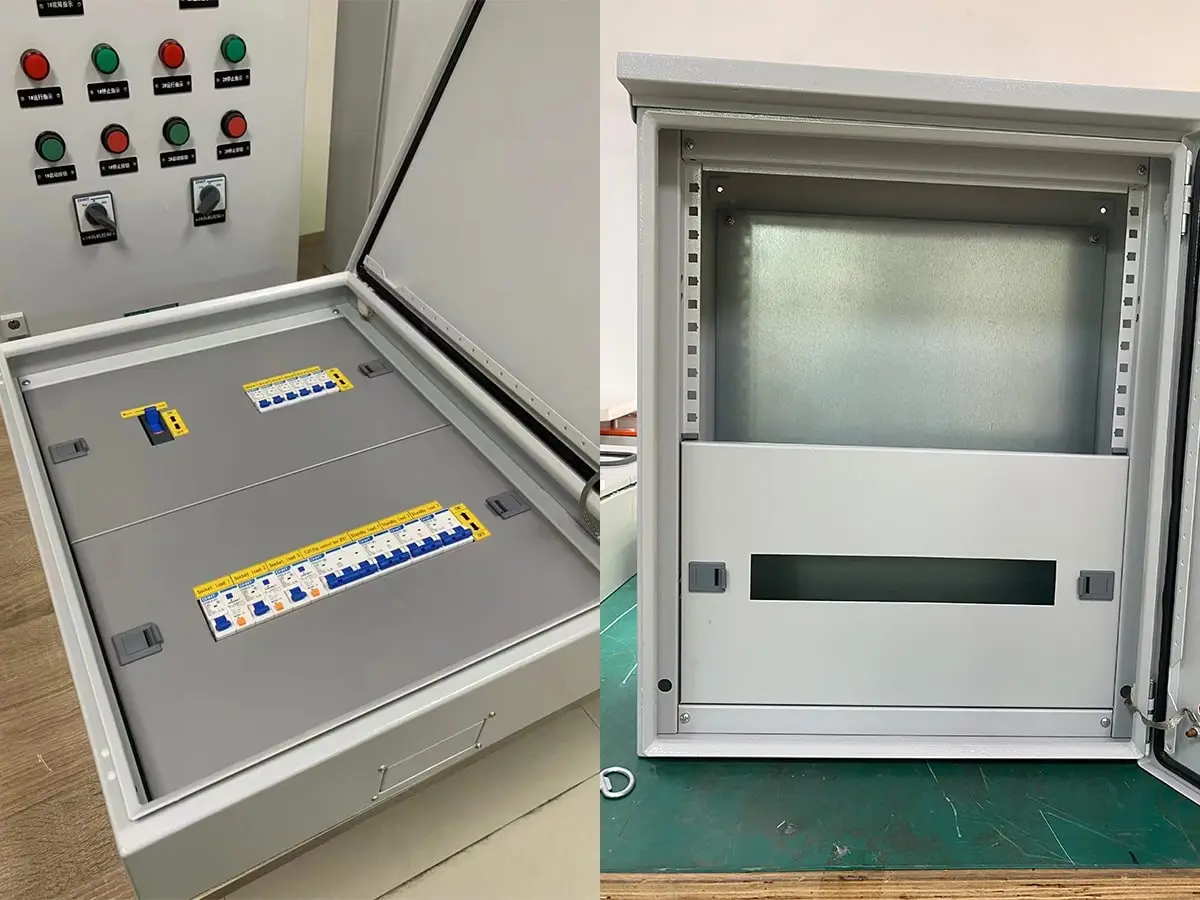
For projects requiring custom dimensions, cable entries, access doors, or environmental protection, Eabel’s electrical enclosure range can be coordinated with the equipment layout early in design. The completed switchboard or switchgear—not the cabinet alone—still requires the applicable evaluation and markings.
Installed space includes more than cabinet width. Allow for working clearances, door swing, ventilation, conductor bending, expansion sections, and safe equipment movement.
Compare total installed and life-cycle cost, not purchase price alone. UL 891 often has a lower first cost and higher power density. UL 1558 can justify added space and cost when outage reduction, maintainability, protection flexibility, or faster replacement has measurable value.
Arc-Flash, Code, and Approval Boundaries
UL 1558 Does Not Automatically Mean Arc-Resistant
Arc-resistant switchgear must be specifically designed and evaluated for internal arcing performance, commonly under IEEE C37.20.7-2024. Buyers need to state the required accessibility type and confirm that the tested construction matches the offered lineup and installation arrangement.
Arc-resistant performance can depend on doors and covers being closed, latches being secured, pressure-relief paths remaining clear, and exhaust systems being installed as tested. A generic note such as “arc-resistant ready” does not establish a rating.
Arc-resistant construction does not eliminate the need for an arc-flash risk assessment. Clearing time, working distance, and operating mode affect incident energy; equipment condition affects the likelihood and safety of the work.
Listing Does Not Replace NEC, Utility, or AHJ Review
A UL listing evaluates equipment against a product standard. It does not approve the complete electrical installation.
The locally adopted edition of NFPA 70 still governs the installation, including Article 408, service-equipment rules, grounding, working space, and conductor requirements.
Depending on the system, NEC requirements may also include selective coordination for emergency, legally required standby, or critical operations power systems.
Arc-energy-reduction provisions also apply to certain fuses rated 1,200 A or higher and circuit breakers rated or adjustable to 1,200 A or higher.
NFPA 70E addresses workplace electrical safety practices. It does not turn a product feature into permission for energized work. The employer’s electrical safety program, risk assessment, procedures, and equipment condition remain relevant.
The utility may impose separate service and metering requirements, while the authority having jurisdiction decides whether the installed work is acceptable. The responsibilities and approval sequence are explained in who approves electrical panel energization.
Even listed equipment can require redesign if its service configuration, field modifications, room layout, or documentation does not match the project.
A UL-listed enclosure should not be described as a UL 891 switchboard or UL 1558 switchgear assembly unless the completed equipment has the corresponding evaluation and marking. Component certification and assembly certification answer different questions.

How to Choose Between UL 891 and UL 1558
Choose the equipment category only after defining system duty. This process keeps a familiar name, preferred manufacturer, or first-cost target from replacing the engineering requirements.
- Calculate every relevant fault-current condition. Document utility, generator, tie, and parallel-source modes. Include credible future changes such as a larger transformer, another generator, or a normally open tie that may later operate closed.
- Define the continuity and coordination objective. Identify which downstream fault must be isolated, which loads must remain energized, and whether coordination is required by code, an owner standard, or an operational risk decision.
- Determine whether assembly short-time duty is required. If an upstream device must delay at high fault current, state the necessary current and duration. This requirement, not a general desire for “heavy-duty equipment,” is a strong reason to evaluate UL 1558.
- Evaluate maintenance and installation constraints. Compare front or rear access, breaker removal, planned outage methods, cable entry, lifting space, environmental exposure, NEMA Type, altitude, seismic needs, and room expansion capacity.
- Verify the exact offered assembly. Review the listing, nameplate SCCR, short-time rating where required, breaker standards, trip units, arc-resistant evidence, drawings, and test documentation. Resolve exceptions before approval, not after equipment arrives.
The decision is often clear after step three. If compact distribution meets the operating plan and no assembly short-time rating is needed, UL 891 is often sufficient. If verified short-time duty and power-breaker protection are essential, prioritize UL 1558.
What to Include in a Specification or RFQ
Writing only “UL 891” or “UL 1558” will not produce comparable bids. The RFQ should define system duty and the evidence required from every supplier.
| Required input | What to state | Why it changes the selection |
|---|---|---|
| Electrical system | Voltage, phase, frequency, and grounding | Establishes the application |
| Continuous current | Main, feeder, and bus ratings | Affects thermal and physical design |
| Available fault current | Value for each source and tie mode | Sets minimum equipment ratings |
| Protective devices | Breaker or fusible-switch types, ampere ratings, and trip units where applicable | Affects interruption, SCCR, and coordination |
| Short-time requirement | Current magnitude and duration | Identifies the required assembly duty |
| Coordination objective | Loads and devices that must remain energized | Guides protection architecture |
| Access and maintenance | Front/rear access, drawout needs, and outage plan | Shapes construction and room layout |
| Installation environment | Indoor/outdoor, NEMA Type, temperature, altitude, and seismic needs | Prevents enclosure and derating errors |
| Arc-resistant requirement | Standard, accessibility type, and installation limits | Prevents unsupported safety claims |
| Project interfaces | Service entrance, utility metering, and AHJ requirements | Reduces approval-stage redesign |
| Future expansion | Added sources, loads, and spare sections | Preserves electrical and physical margin |
| Documentation | Listing, nameplate data, drawings, and test evidence | Makes proposed assemblies verifiable |
Avoid phrases such as “UL 1558 equivalent,” “high fault rated,” or “arc-resistant ready” unless the supplier defines and proves them. The requested rating must apply to the complete offered assembly, not just a breaker, bus component, or empty cabinet.

FAQs About UL 891 vs UL 1558
Conclusion

UL 891 suits conventional distribution, while UL 1558 better supports verified short-time duty, power breakers, and service-focused designs. Contact Eabel with your one-line diagram, ratings, fault current, access needs, and site conditions to discuss the right enclosure and distribution approach.
Related Reading
Electrical Switchgear 101: Basics and Types Guide
Arc-Resistant vs Standard Switchgear: Which Is Safer
Withdrawable vs Fixed Switchgear: Best Choice Guide
Switchgear vs Circuit Breakers: Key Differences



 EN
 ES
 FR
 AR
 JA
 KO
 RU
 DE
 PT
 IT
 ZH
 TH
 VI
 HI
 MS
