

UL 508A vs UL 67 vs UL 891 at a Glance
| Standard | Complete product | Primary function | Typical system position | Critical boundary |
|---|---|---|---|---|
| UL 508A | Industrial control panel | Control industrial machinery or processes | At or within industrial equipment | Panel certification does not automatically cover the complete machine or remote loads |
| UL 67 | Panelboard | Control, protect, and divide electrical circuits | Service or downstream distribution, depending on the certified construction | Factory-wired industrial process-control assemblies are outside its scope |
| UL 891 | Dead-front switchboard | Provide centralized power distribution | Service entrance or main distribution, when appropriately certified and marked | The actual SCCR marking governs; switchboards with short-time ratings are outside its scope |
This comparison provides an initial direction. Final classification also depends on construction, electrical ratings, certification scope, system position, and required markings.
UL 508A: Industrial Control Panels
UL 508A covers industrial control panels rated 1,000 V or less for general industrial use. A panel can contain power circuit components, control circuit components, or both.
Common components include motor controllers, overload relays, disconnect switches, circuit breakers, relays, PLCs, and variable-frequency drives. Typical applications include machine control, production lines, material-handling equipment, HVAC systems, and process automation.
A UL 508A panel may distribute power internally, but its main purpose is generally to control industrial equipment or a process. The presence of circuit breakers does not automatically make it a UL 67 panelboard or UL 891 switchboard.
UL 508A also covers industrial control panels intended for service-equipment use. However, that suitability must be addressed by the applicable construction requirements and confirmed through the delivered panel’s certification information and markings. Service-equipment use alone does not classify an assembly as a UL 67 panelboard or UL 891 switchboard.
Its certification also has clear limits. UL 508A evaluates the industrial control panel, not automatically the motors, heaters, machines, or other loads connected to it. It also does not confirm that the control logic performs the intended process correctly or that every safety function of the finished machine is adequate.
Panel classification does not replace industrial control panel enclosure selection. For an enclosed assembly, the required Type rating must apply to the finished construction, including doors, openings, operators, ventilation devices, cable entries, and other through-wall components. It must also suit the installation environment, cooling method, and required service access.
UL 508A remains in its third edition and was revised in June 2025.
UL 67: Panelboards
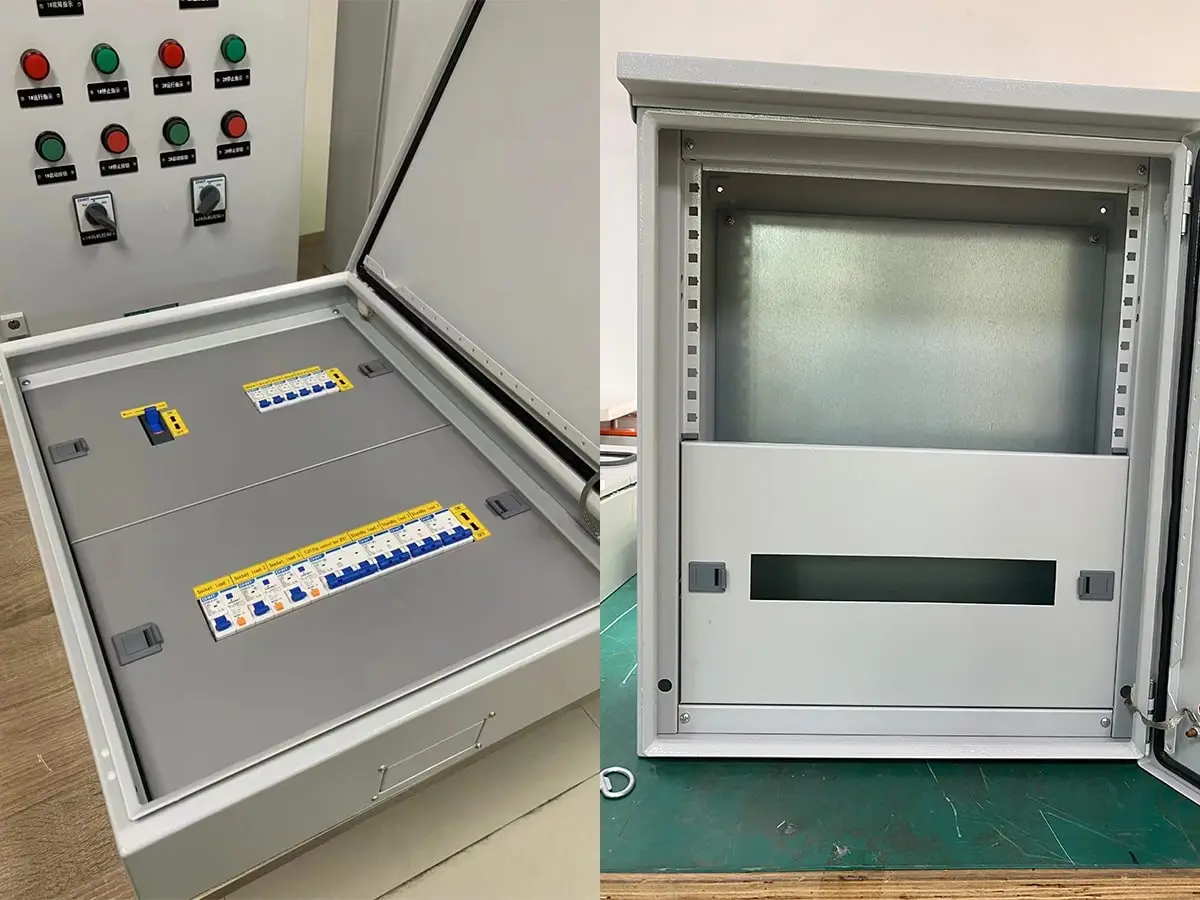
UL 67 covers panelboards whose primary function is the control and protection of electrical circuits. A panelboard normally includes buses, connections, automatic overcurrent devices, and optional switches or control apparatus.
Its structure is an important clue. A panelboard is designed to be placed in a cabinet or cutout box installed in or against a wall, partition, or other support. It is accessible only from the front and is commonly used for downstream feeder and branch-circuit distribution.
A panelboard may include metering, monitoring, switches, or limited control functions. These components do not make it an industrial control panel if circuit control and protection remain its primary purpose. UL 67 specifically excludes factory-wired assemblies intended mainly to control industrial processes; those assemblies are addressed by UL 508A.
Buyers who need more detail on buses, main devices, branch circuits, and enclosure layouts can review this guide to distribution panel parts and selection.
The fourteenth edition of UL 67 was published in July 2026. Its updates were primarily editorial and did not materially change the basic product classification.
UL 891: Dead-Front Switchboards
UL 891 applies to dead-front switchboards rated 1,000 V or less. These assemblies are commonly used for main and centralized power distribution. They may also serve at the service entrance when the specific construction is certified and marked for that use.
“Dead-front” means that no live parts are exposed to a person on the operating side of the equipment.
A UL 891 switchboard is normally a freestanding assembly containing buses, main and feeder overcurrent devices, metering, and related equipment. Its busbar power distribution design can serve multiple large feeders across a single- or multi-section lineup.
The scope of UL 891 covers switchboards used on circuits with available short-circuit current up to 200,000 A. This does not mean every UL 891 switchboard has a 200 kA short-circuit current rating. The actual assembly SCCR must appear on its marking and must be suitable for the available fault current at the installation point.
UL 891 does not cover switchboards with short-time current ratings. Projects requiring short-time withstand capability or low-voltage power circuit breakers may instead fall under UL 1558.
The current twelfth edition was revised in March 2025. The revision addressed multiple-source switchboards, forced-air cooling, emergency circuits, and service-equipment construction.

How the Standards Differ in Real Projects
These product categories often work in sequence rather than compete for the same role. A typical industrial power path is:
Utility or transformer → UL 891 main switchboard → UL 67 downstream panelboard → UL 508A machine control panel → motors or production equipment
This is a common arrangement, not a mandatory hierarchy. UL 67 panelboards and UL 891 switchboards may be used at other distribution levels when their certification, ratings, and installation conditions are suitable. A UL 508A panel may also be evaluated for service-equipment use.
The switchboard handles centralized distribution, the panelboard divides power into smaller circuits, and the industrial control panel operates a machine or process. This system-level view is more reliable than classifying equipment by one component, cabinet size, or ampere rating alone.
Physical architecture matters, but it is not decisive on its own. UL 67 panelboards are front-access assemblies, UL 891 switchboards are normally freestanding, and UL 508A panels may be wall-mounted, floor-mounted, freestanding, or integrated into industrial equipment.
A freestanding cabinet is not automatically a switchboard, and a wall-mounted enclosure is not automatically a panelboard.
The same caution applies to current ratings. Commercial panelboard product lines often reach about 1,200 A, while switchboard products may reach several thousand amperes. These are common manufacturer capabilities, not universal classification limits. The actual listed design and marked ratings control the application.
Fault-current terminology must also be used carefully. SCCR applies to the complete assembly. Interrupting rating applies to a protective device, such as a circuit breaker or fuse, and states the fault current it can safely interrupt.
“AIC” is common industry wording, but “interrupting rating” is the more precise code term. A breaker with a high interrupting rating does not automatically give the entire assembly the same SCCR.
Environmental protection is a separate issue. Understanding IP and NEMA rating differences helps define protection against water, corrosion, and dust, but an enclosure rating does not certify the internal assembly to UL 508A, UL 67, or UL 891.

When Control and Distribution Share One Assembly
Classification becomes more difficult when one enclosure contains both industrial control equipment and substantial power-distribution equipment.
For example, an automation panel may contain PLCs, relays, motor starters, and VFDs while also using buses and multiple overcurrent devices to distribute power to lighting, heating, receptacles, or other circuits. Calling the complete assembly a “control panel” does not remove the requirements that apply to its distribution section.
UL 508A addresses this boundary. An assembly of buses and overcurrent protective devices for light and power circuits, when provided as part of an industrial control panel, must be evaluated to UL 67. A freestanding assembly of buses and overcurrent devices for light and power circuits, or equipment intended for installation in a dead-front switchboard, must be evaluated to UL 891.
This does not mean every mixed-function cabinet receives two separate certification marks. It means the end-product evaluation may need to apply requirements from more than one standard. The final certification category and marking depend on the complete construction and certification path.
Mixed-function equipment should be classified before the enclosure layout, bus design, component selection, and certification plan are finalized. Waiting until the cabinet is built can lead to changes in spacing, wire-bending space, protection, labeling, or internal separation.
In some projects, separating the functions is more practical. A dedicated UL 67 panelboard or UL 891 switchboard can handle power distribution, while a separate UL 508A panel handles machine control. This can simplify certification, maintenance, future expansion, and supplier responsibility, although separation is not required in every application.
Once the correct product category is established, the enclosure must still match the required mounting style, internal layout, access, and operating environment. E-abel offers electrical enclosure options in wall-mounted, free-standing, modular, and custom formats. The enclosure must remain compatible with the complete assembly’s certification path; selecting a rated enclosure alone does not certify the finished panel or switchboard.
How to Choose the Right Standard
- Define the primary function. Decide whether the assembly mainly controls industrial equipment, divides and protects circuits, or provides centralized power distribution. Describe that function in one clear sentence before discussing cabinet dimensions or brands.
- Locate the equipment on the one-line diagram. Determine whether it will be installed at the service entrance, main distribution point, downstream distribution level, or next to a machine. System position often reveals an incorrect product description early.
- Confirm the electrical ratings. Record the system voltage, phase, frequency, main ampere rating, largest feeder, conductor details, and expected loads. Do not use typical catalog ranges in place of the marked ratings of the actual assembly.
- Determine the available fault current. Obtain the available fault current at the installation point. Confirm that the assembly SCCR and protective-device interrupting ratings are adequate. For UL 508A panels, Supplement SB provides a recognized method for determining SCCR when its conditions are met.
- Check service and installation requirements. Confirm whether the equipment must be suitable for use as service equipment. Also define mounting, access, cable-entry direction, working clearance, indoor or outdoor installation, and the required enclosure type.
- Verify the certification path. Confirm the product category, standard, certification mark, and certification organization with the manufacturer, project specifier, certification body, and AHJ. Complete this step before production, especially for custom or mixed-function assemblies.
A useful request for quotation should include the one-line diagram, load schedule, available fault current, service requirements, enclosure type, cable-entry direction, installation conditions, target market, and required certification. A request that only says “UL electrical panel” is not detailed enough for dependable design or pricing.

Compliance and Purchasing Checks
“Built to UL” Is Not the Same as Listed
Terms such as “built to UL,” “designed to UL,” and “UL compliant” may describe a manufacturer’s design claim. They do not necessarily mean that an independent certification organization has evaluated and listed the product.
UL Solutions is one certification provider, but other Nationally Recognized Testing Laboratories can also certify products to standards within their recognized scope. Each NRTL uses its own certification mark. OSHA explains this distinction through its NRTL Program.
Buyers should therefore identify both the applicable product standard and the organization that issued the certification.
Listed Components Do Not Certify the Assembly
Using UL Listed or UL Recognized components is often necessary, but it does not automatically certify the completed panel. The complete assembly must still meet requirements for component use, wiring, spacing, grounding, protection, temperature, construction, and marking.
A UL Listed enclosure also does not make the equipment installed inside it a UL 508A industrial control panel, UL 67 panelboard, or UL 891 switchboard.
Verify the Product, Marking, and Rating
Check the certification mark on the actual product rather than relying only on a brochure, quotation, or general factory certificate. Confirm the product or category name, manufacturer or Listee, file or control number, covered model, voltage and current ratings, assembly SCCR, enclosure rating, and service-equipment marking where required.
Certifications issued by UL Solutions can be checked through UL Product iQ. For products certified by another NRTL, use that organization’s certification directory. If the exact manufacturer, model, and product category cannot be verified, request the certificate, file information, and evidence that the proposed assembly is covered.
A factory certificate or certification for one product family does not automatically cover every model or custom assembly produced at that facility.
Control Field Modifications
Adding breakers, modifying buses, changing wiring, or replacing components outside the documented design after shipment may place the product outside its original certification.
The AHJ determines whether a modified installation is acceptable and whether a field evaluation is needed. A UL or other NRTL certification mark may be applied only under the certifying organization’s authorization and follow-up program; unlabeled or materially modified equipment may instead require a field evaluation.
Check Related Codes and Product Standards
NEC Article 408 addresses switchboards, switchgear, and panelboards, while Article 409 addresses industrial control panels. UL 50E covers environmental enclosure ratings, UL 489 covers molded-case circuit breakers and related devices, and UL 869A provides reference requirements for service equipment.
Some assemblies fall outside all three standards compared here. Motor control centers are covered by UL 845, transfer switch equipment by UL 1008, and low-voltage power circuit breaker switchgear with short-time ratings by UL 1558. Hazardous-location applications may involve UL 698A, UL 1203, or other specialized standards.
The latest UL standard edition and the locally adopted NEC edition are separate matters. States and local jurisdictions do not adopt each new NEC edition at the same time, so project requirements must be checked against the code in force at the installation location.

FAQs About UL 508A vs UL 67 vs UL 891
Conclusion
UL 508A, UL 67, and UL 891 are not three sizes of the same electrical panel. UL 508A addresses industrial control panels, UL 67 addresses panelboards, and UL 891 addresses dead-front switchboards. The correct choice begins with the assembly’s primary function and construction, then checks its system position, ratings, available fault current, service requirements, environment, and certification scope.
If you are planning a North American control or power-distribution project, contact E-abel with your one-line diagram, load schedule, available fault current, installation environment, and required certification. Our team can help review the enclosure and assembly requirements and develop a practical configuration for your application.
Related Reading
How UL Certification Works for Industrial Enclosures
UL Listed Enclosures: What Buyers Must Know
Control Panel vs Enclosure: What to Buy?
How to Choose the Right Panelboard



 EN
 ES
 FR
 AR
 JA
 KO
 RU
 DE
 PT
 IT
 ZH
 TH
 VI
 HI
 MS
