

How Electrical Enclosures Protect Commercial HVAC Controls

Electrical enclosures are used throughout commercial HVAC systems to house control and power components while protecting them from contact and environmental exposure. NEMA describes an electrical enclosure as a cabinet or box used to protect electrical or electronic equipment, with different enclosure Types intended for different environmental conditions.
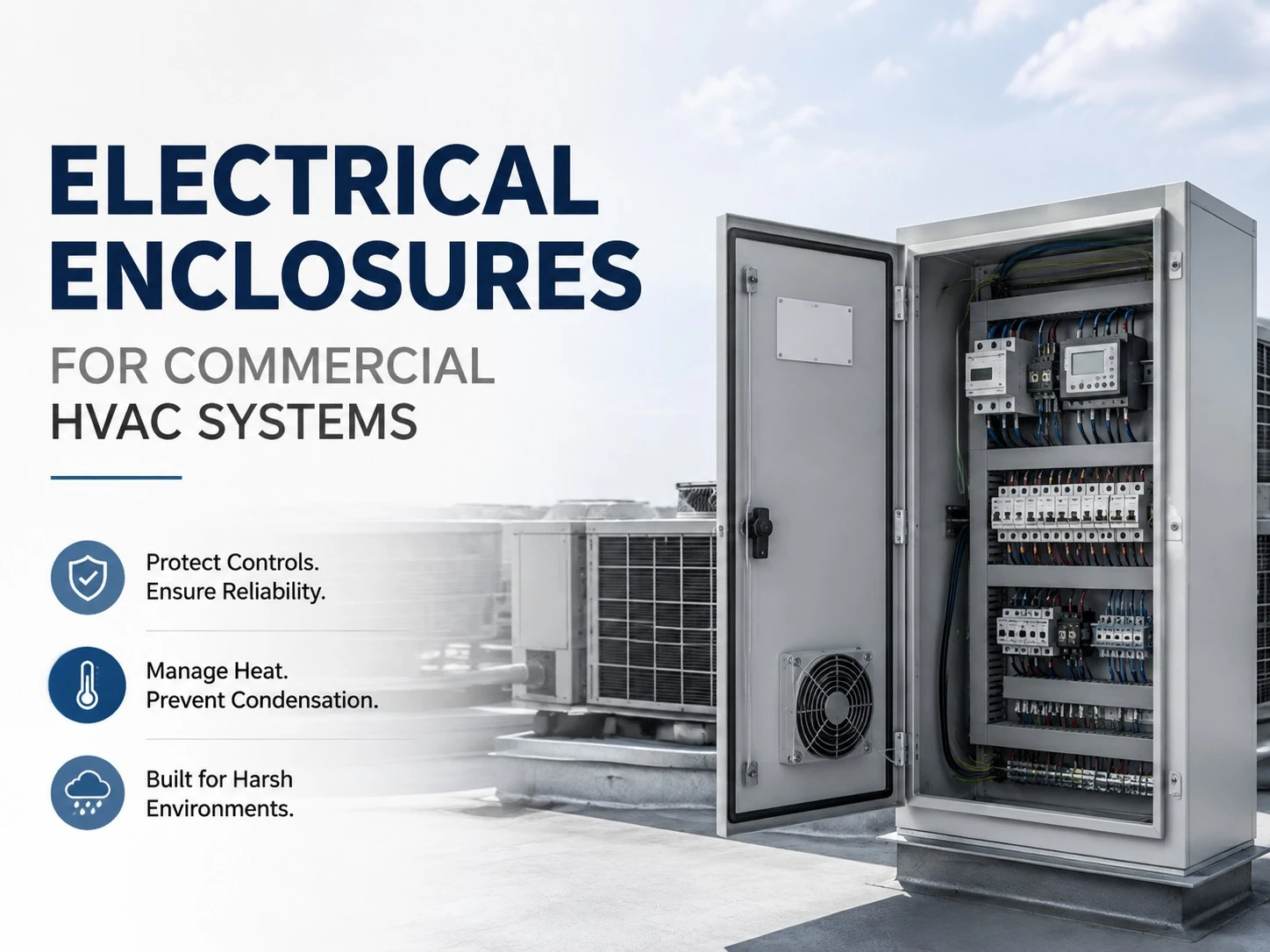
Depending on the system, an HVAC control enclosure may contain VFDs, DDC or PLC controllers and I/O modules, relays, contactors, circuit protection, power supplies, transformers, terminal blocks, and communication hardware.
These enclosures appear on rooftop units, air handling systems, chillers, cooling towers, pumps, fans, ventilation systems, heat pumps, and central mechanical-room controls. The equipment name alone, however, does not determine the correct enclosure.
An AHU panel inside a clean mechanical room faces very different conditions from a rooftop cabinet exposed to rain and direct sun. A cooling-tower installation adds persistent moisture, while a coastal rooftop can introduce salt-driven corrosion. Installation conditions should therefore drive enclosure selection.
An enclosure is also only one part of a complete HVAC control panel. For a broader look at enclosure selection, see this industrial control panel enclosure guide. The finished panel adds installed components, wiring, protective devices, markings, and assembly-level ratings. UL 508A applies to industrial control panels, so these panel-level requirements should be evaluated separately from the environmental Type of an empty enclosure.
Choosing the Right Enclosure Type and Material
Start with one question: What will the enclosure actually be exposed to?
The current ANSI/NEMA EN 10250-2024 enclosure standard covers enclosure Types for electrical equipment up to 1000 V in defined indoor, outdoor, and certain classified locations. These Types address specific environmental conditions and should not be treated as a simple ladder where a higher number is always better.
| Installation Condition | Common Type to Evaluate | Main Concern | Typical HVAC Example |
|---|---|---|---|
| Clean indoor area | 유형 1 | Contact and falling dirt | Protected indoor controls |
| Dusty or dripping indoor area | 유형 12 | Dust and dripping liquids | Mechanical-room panel |
| 야외 비 노출 | 3R형 | 비, 눈, 진눈깨비 | Rooftop HVAC controls |
| Wet or harsh outdoor area | 유형 4 | Water and windblown dust | Exposed HVAC equipment |
| Wet and corrosive area | 유형 4X | Water plus corrosion resistance | Coastal or corrosive site |
This table is a starting point, not a substitute for the project specification. The required Type can also depend on the equipment design, applicable product Listing, installation instructions, and authority having jurisdiction.
NEMA 4X Is Not the Default for Every HVAC Project
Type 4X is a strong option when an installation requires substantial water protection together with corrosion resistance. That makes it relevant to many coastal, wet, washdown, and corrosive environments.
But specifying Type 4X for every commercial HVAC enclosure can add cost without solving a real engineering problem. A protected indoor panel, a rooftop cabinet exposed mainly to weather, and a coastal enclosure have different exposure profiles. Select the Type from those conditions instead of treating 4X as a blanket minimum.

NEMA Type Is Not the Same as Certification
“NEMA certified” is an imprecise phrase. NEMA develops standards but does not itself certify, test, or inspect products, designs, or installations.
A third-party organization can evaluate an enclosure or finished product to applicable requirements. UL enclosure and component certification, for example, covers Type-rated electrical enclosures and related components as well as IP Code ratings.
For a U.S. project, keep three questions separate: what environmental Type is required, what evaluation or standard applies, and whether the enclosure or finished panel needs a specific Listing or certification.
IP and NEMA/UL Type ratings should also be treated as separate systems rather than assumed to be exact one-to-one equivalents.
Match the Material to the Environment
Once the required protection is understood, select a material that fits the exposure, fabrication needs, weight, and budget.
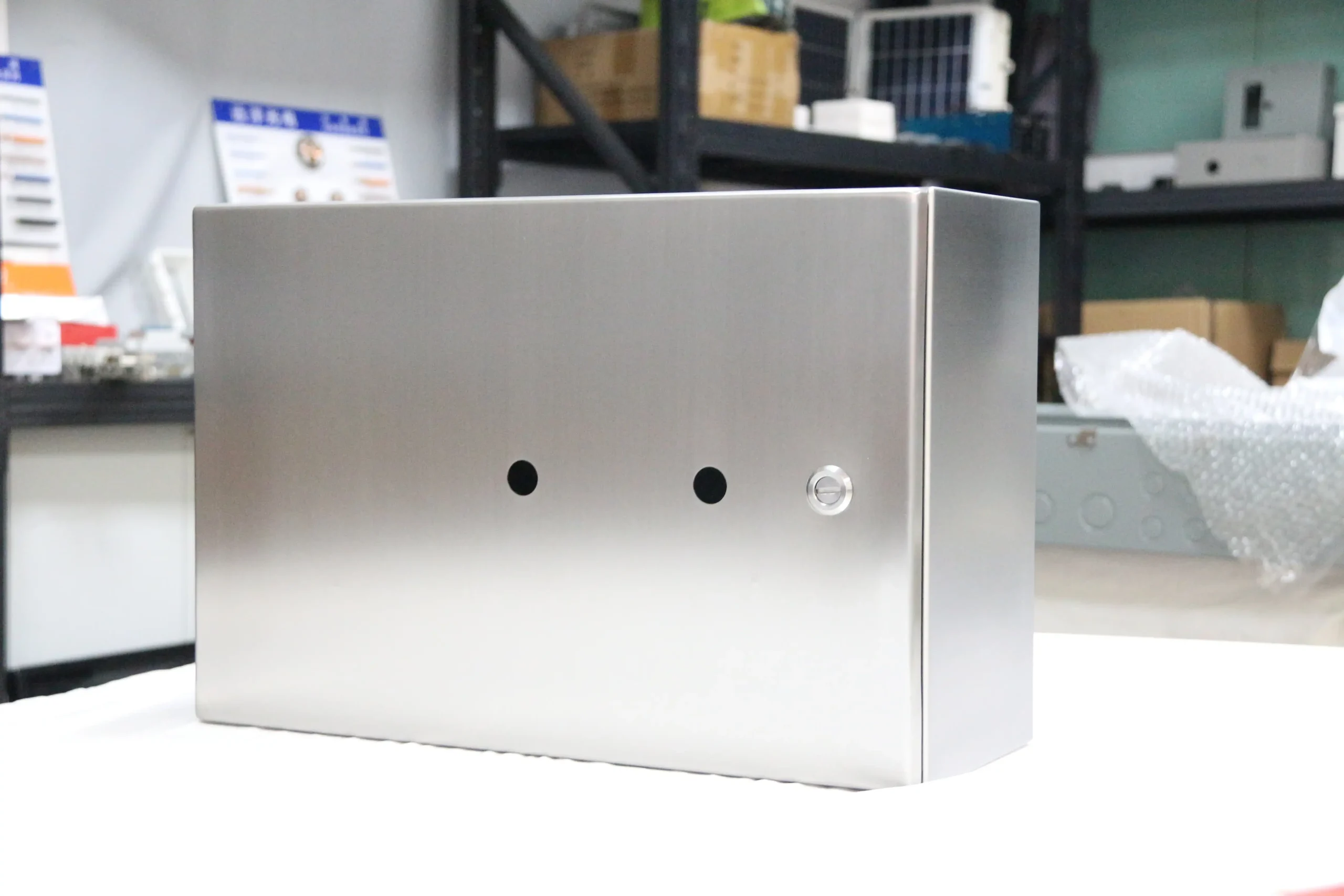
Painted mild or carbon steel is widely used for protected industrial controls. Stainless steel is available in grades such as 304 and 316 for more demanding environments, while aluminum and fiberglass provide additional options where weight, corrosion, or nonmetallic construction matters. Major enclosure manufacturers offer these materials across different Type ratings, reinforcing an important point: material and enclosure Type are related decisions, but they are not the same decision.
For many indoor HVAC applications, painted steel provides a practical balance of rigidity and cost. Stainless steel becomes more attractive as moisture and corrosive exposure increase. Type 316 or 316L is often considered for environments involving stronger chloride or salt exposure, while fiberglass can be useful where corrosion resistance and nonconductive construction are valuable.
A stainless-steel cabinet is not automatically Type 4X, and a Type 4X requirement does not by itself specify the best material. The complete enclosure construction still has to meet the intended rating.
Managing Heat and Condensation
Environmental Type ratings do not solve every condition inside a cabinet. ANSI/NEMA EN 10250-2024 specifically excludes protection against conditions such as internal condensation and thermal damage, as well as contamination that may enter through conduit or unsealed openings. These risks need separate design attention.
For an HVAC enclosure, thermal assessment should consider internal component heat losses, ambient temperature, direct solar exposure, enclosure dimensions and surface area, component temperature limits, humidity, and condensation risk.
VFDs, power supplies, transformers, contactors, and other electronics can all add heat. Rooftop cabinets deserve extra attention because direct solar gain can combine with these internal losses. For this reason, ambient air temperature alone is not enough to judge rooftop enclosure performance.
Where available, use manufacturer-published heat-loss, clearance, and operating-temperature data instead of estimating requirements from component size alone.
Choose Cooling Without Defeating the Enclosure
Low-heat panels may be able to dissipate heat through the enclosure surface. Filtered fans can increase airflow when exchanging outside air is acceptable.
Where the surrounding air contains excessive dust, moisture, or corrosive contaminants, a more isolated thermal solution may be appropriate. Depending on the heat load and target temperature, this can include heat exchangers or enclosure air-conditioning systems.
The key rule is simple: a thermal-management method should not defeat the environmental protection the enclosure was selected to provide.
Fans, air conditioners, heat exchangers, cable-sealing devices, windows, and similar accessories become part of the finished enclosure system. UL therefore evaluates these types of enclosure-related components and accessories as part of maintaining defined environmental protection.
Do Not Overlook Condensation
Overheating is only one risk. Outdoor and semi-outdoor enclosures can experience large day-to-night temperature changes, and condensation can form when an internal surface falls below the dew point.
Depending on the application, control measures may include enclosure heaters, controlled ventilation, or properly selected breathers and drains. The chosen method still needs to preserve the required environmental protection.
Maximum temperature and condensation risk should be evaluated separately. Solving one does not automatically solve the other, and enclosure Type alone does not provide a complete answer to internal condensation.
Designing for VFDs, DDC/PLCs, and BMS Integration
Modern commercial HVAC controls often place more electronics inside an enclosure than older relay-based systems. VFDs, PLCs, communication gateways, network hardware, and BMS interfaces can all affect cabinet size and layout.
VFDs deserve particular attention because they generate heat, require manufacturer-defined installation clearances, and can introduce electrical noise into nearby control and communication circuits. Drive manufacturers provide specific instructions for cable type, shielding, grounding, and routing.
The enclosure layout should therefore make room not only for the drive itself but also for proper cable routing, grounding, clearances, and service access. Manufacturer instructions for the specific VFD take priority over generic panel-layout rules.
PLC and control layouts should keep terminals, I/O modules, circuit protection, DIN rail, wire ducts, and communication hardware accessible. Practical space for major component replacement and expected future expansion can also prevent difficult service work later.
The smallest enclosure that fits the BOM is not necessarily the best enclosure for the project. A cabinet may physically hold every component yet still be too crowded for correct wiring, thermal management, commissioning, or maintenance.
Plan BMS Integration Before Finalizing the Layout
Commercial HVAC equipment may communicate with a building automation system through BACnet, Modbus, or another project-specified interface.
ANSI/ASHRAE Standard 135-2024 is the current published BACnet standard for building automation and control networks, while ASHRAE Guideline 13-2024 provides recommendations for specifying BAS used in HVAC control applications.
From an enclosure perspective, define the required controllers and gateways, network hardware, communication-cable routes, I/O and expansion capacity, and service access before finalizing the layout.
These requirements are much easier to accommodate during panel design than through field additions after fabrication.
For network-connected BAS panels, physical access control and cybersecurity should also be considered together. A lockable enclosure can limit unauthorized physical access, but it does not replace proper network authentication, access control, and cybersecurity practices.
Safety and Compliance Requirements
An enclosure Type addresses defined environmental conditions. It does not answer every electrical-safety or control-panel compliance question.
UL 508A Applies to Industrial Control Panels
UL 508A industrial control panel requirements apply to constructed industrial control panels, including areas such as power circuits, control circuits, ratings, markings, components, and enclosure construction.
For that reason, describing an empty cabinet simply as a “UL 508A-certified enclosure” can be misleading.
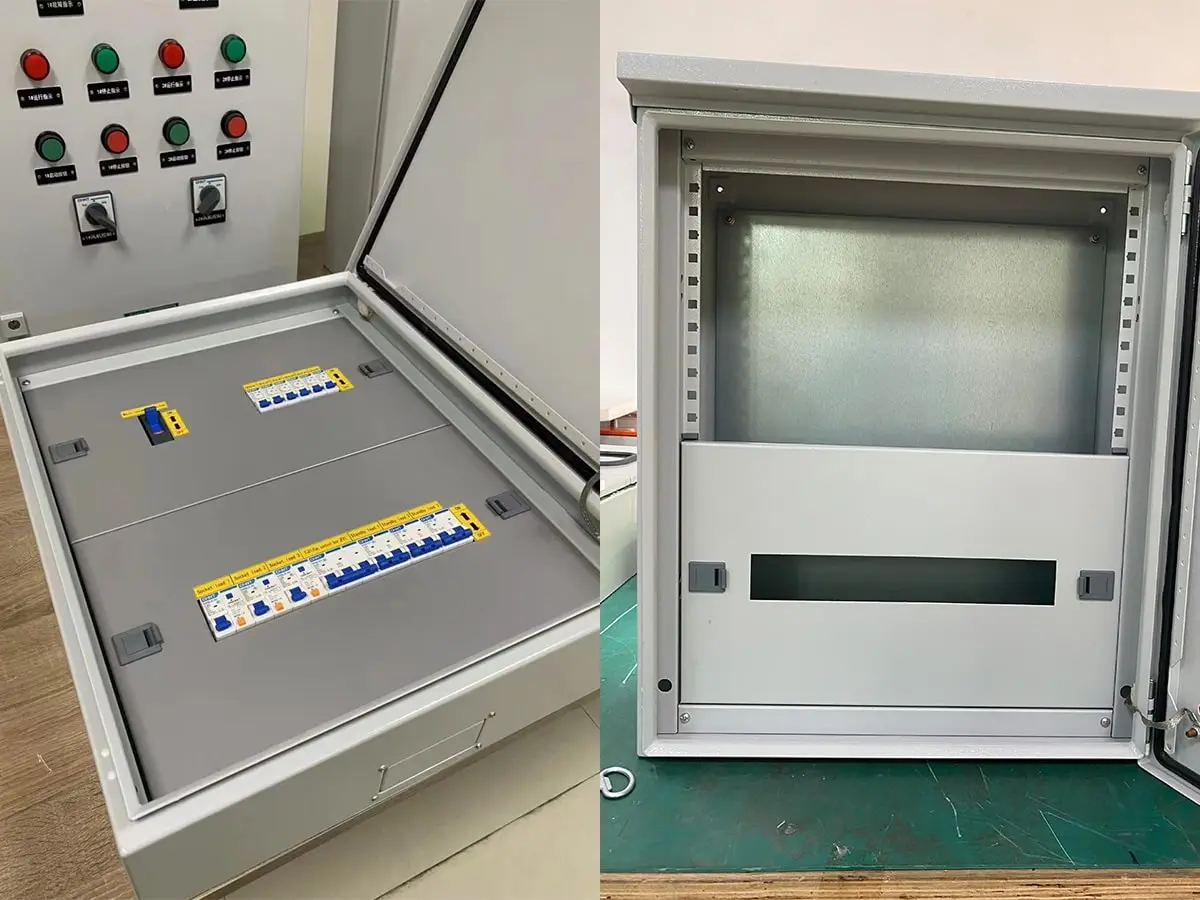
Where a project requires a UL Listed industrial control panel, the enclosure, installed components, wiring, protection, markings, and other construction details must work together within the applicable panel requirements.
Metallic enclosures and other conductive panel parts also need appropriate grounding and bonding provisions. For a listed industrial control panel, grounding terminals, bonding components, and installation methods should be selected and applied in accordance with the applicable panel requirements.
SCCR Answers a Different Question
Short-Circuit Current Rating, or SCCR, is a panel-level electrical rating rather than an environmental enclosure rating.
NEC Article 409 requires industrial control panels to be marked with an SCCR, and UL 508A Supplement SB provides an accepted method for determining the SCCR of an industrial control panel.
The panel SCCR must be suitable for the available fault current at the installation. A stainless Type 4X enclosure does not increase SCCR by itself because environmental Type and SCCR address different risks.
Check the Code Adopted by the Project Jurisdiction
The 2026 edition is currently the newest published edition of NFPA 70, the National Electrical Code. However, the edition legally enforced at a project location can differ because states and local jurisdictions adopt NEC editions on different schedules.
For that reason, a commercial HVAC project should verify the locally adopted NEC edition, applicable amendments, project specifications, equipment standards, and AHJ requirements using resources such as the NFPA NEC enforcement map rather than assuming that the newest published NEC edition is automatically the governing code.
How to Specify an Electrical Enclosure for HVAC
A good commercial HVAC enclosure RFQ does not need unnecessary detail. It needs the information that materially changes the design, rating, cost, or manufacturability.
- Define the application and installation location. State whether the enclosure serves an AHU, rooftop unit, chiller, cooling tower, pump, fan system, or central HVAC controls, then describe where it will be installed. The equipment name alone is not enough to determine the correct enclosure.
- Describe the environment. Identify indoor or outdoor use, direct weather exposure, dust, dripping or sprayed water, corrosive chemicals or salt air, direct sunlight, ambient-temperature range, and humidity concerns. This information drives both enclosure Type and material selection.
- Identify whether the project is new construction or a retrofit. For retrofit work, provide existing conduit locations, cable lengths, available mounting space, incoming voltage, BMS connections, and shutdown constraints. A replacement cabinet often has to work around infrastructure that cannot be moved economically.
- Define Type, material, dimensions, and mounting. If the project specification already defines an environmental Type, state it clearly. Also provide the preferred material, maximum dimensions, mounting method, door arrangement, mounting-plate requirements, and any access limitations.
- Provide the component list. For a populated enclosure, identify major VFDs, PLCs, I/O, protective devices, transformers, power supplies, relays, contactors, HMIs, terminal blocks, and communication hardware. A preliminary BOM is more reliable than selecting cabinet dimensions by guesswork.
- Define thermal conditions. Provide ambient-temperature limits, solar exposure, known component heat losses, required internal operating conditions, and any humidity or condensation concerns. Thermal requirements should be considered before fabrication rather than after overheating appears during commissioning.
- Identify all planned penetrations and accessories. Define HMI openings, disconnects, windows, operator devices, cable glands, gland plates, cooling equipment, antennas, and other openings before fabrication. The finished assembly—not just the empty cabinet—must meet the intended environmental and project requirements. ANSI/NEMA EN 10250-2024 also makes clear that contamination entering through conduit or unsealed openings is outside the basic enclosure protection covered by the standard.
- Define compliance, testing, and documentation. State any required enclosure or panel Listing, UL 508A construction, SCCR, local code requirements, drawings, wiring schematics, BOM, terminal plans, labels, certification records, and FAT or other acceptance testing. For BAS projects, ASHRAE Guideline 13-2024 also treats testing and documentation as important parts of a BAS specification.

Avoid Unplanned Field Modifications
Cutouts and accessories deserve special attention because the enclosure delivered from the factory is not necessarily the enclosure that remains after installation.
Adding an HMI, disconnect, fan, antenna, cable entry, or another penetration in the field can affect sealing, environmental protection, component spacing, and the documented configuration of certified equipment.
UL states that when a Listed product is modified after leaving the factory, an AHJ must determine whether the change is acceptable or significant enough to require further evaluation; a UL Field Evaluation can be used to assess the modified equipment against applicable requirements.
Where a documented environmental rating or certification must be preserved, factory-planned modifications are generally easier to control than unplanned field work.
When Does a Custom HVAC Enclosure Make Sense?
A standard enclosure is often the most efficient option when the environment, dimensions, and component layout are straightforward. Buyers who are still comparing available form factors can review Eabel’s enclosure range before deciding whether a custom design is necessary.
Customization becomes more useful when a commercial HVAC project has tight retrofit dimensions, several large VFDs, unusual thermal loads, demanding rooftop or corrosive exposure, custom HMI or door layouts, special cable-entry locations, integrated BMS hardware, project-specific thermal management, or repeat production that requires consistent fabrication.
Custom does not automatically mean better. It should solve a real environmental, dimensional, thermal, integration, or manufacturing problem.
For repeat HVAC equipment programs, however, factory-defined openings, mounting provisions, and controlled drawings can reduce unit-to-unit variation and limit field modifications.

FAQs About Electrical Enclosures for Commercial HVAC Systems
결론

Choosing the right electrical enclosure for a commercial HVAC system requires more than selecting a NEMA Type. The enclosure should match the installation environment, material requirements, internal heat load, condensation risk, control components, service needs, and applicable panel and code requirements.
If you are sourcing an enclosure for a new HVAC system, retrofit, or repeat production project, 문의하기 with your HVAC application, installation environment, required Type rating, dimensions, component list or BOM, drawings, thermal requirements, and order quantity. Our team can help evaluate the enclosure configuration, material, thermal management, customization, and manufacturing approach for your project.
관련 자료
304 스테인리스강과 316 스테인리스강 인클로저의 차이점은 무엇입니까?



 KO
KO  EN
EN  ES
ES  FR
FR  AR
AR  JA
JA  RU
RU  DE
DE  PT
PT  IT
IT  ZH
ZH  TH
TH  VI
VI  HI
HI  MS
MS 