

Map the Production Line Before Choosing Enclosures
The same automated production line may need several enclosure types. Dividing the line into installation zones first helps avoid over-specifying cabinets in protected areas while leaving machine-side equipment under-protected.
Central Control Cabinets
Large floor-standing or modular cabinets suit applications where PLCs, drive groups, power distribution, network equipment, and other controls are centralized. Buyers deciding between cabinet formats can compare the practical differences between wall-mount and floor-standing PLC enclosures.
These cabinets need enough mounting area, wiring space, service clearance, and thermal capacity for the installed equipment. Modular designs can also support later expansion when additional control sections are required.
The choice between modular and fixed configurations should reflect expected system growth, access requirements, installation space, and environmental protection rather than cabinet size alone.

Machine-Side and Local Enclosures
Local enclosures may contain remote I/O, terminal blocks, machine controls, or smaller drive assemblies. Locating these components closer to the equipment can reduce long field-wire runs and simplify local troubleshooting.
Their environment can be more demanding than that of a main control cabinet. Oil mist, particles, vibration, heat, washdown, and physical contact often increase close to production machinery.
A smaller machine-side enclosure can therefore require stronger environmental protection than a much larger cabinet serving the same line.
Operator and HMI Enclosures
Operator stations have different priorities. HMIs, pushbuttons, selector switches, indicators, and other controls require frequent access and often penetrate the enclosure wall.
Visibility, ergonomics, mounting position, physical strength, sealing, and the ratings of installed through-wall devices all matter.
The practical rule is simple: map each enclosure location before specifying the enclosure itself.
For production lines that need a mix of wall-mount, free-standing, modular, PLC, or operator-interface cabinets, using a compatible enclosure range can simplify specification and future changes. Eabel’s armoires électriques cover these enclosure formats, allowing buyers to match different cabinet types to different zones of the same production line.
Match Protection, Material, and Construction to the Environment
Start with the actual exposure rather than choosing a NEMA or IP rating first. Dust, oil, water, chemicals, humidity, corrosion, temperature, vibration, and impact determine what the enclosure needs to withstand.
| Zone d'installation | Main Exposure | Enclosure Priority | Key Design Check |
|---|---|---|---|
| Clean indoor control area | Dust and accidental contact | General industrial protection | Access and maintenance |
| Dusty or oily machine area | Particles and oil | Sealed construction | Gaskets and cable entries |
| Zone de lavage | Water and cleaning agents | Washdown protection | Seals and corrosion resistance |
| Corrosive process area | Chemicals and moisture | Corrosion-resistant construction | Compatibilité des matériaux |
| Hot production zone | Ambient and internal heat | performances thermiques | Heat load |
| High-traffic machine area | Impact and vibration | Résistance mécanique | Mounting and hardware |
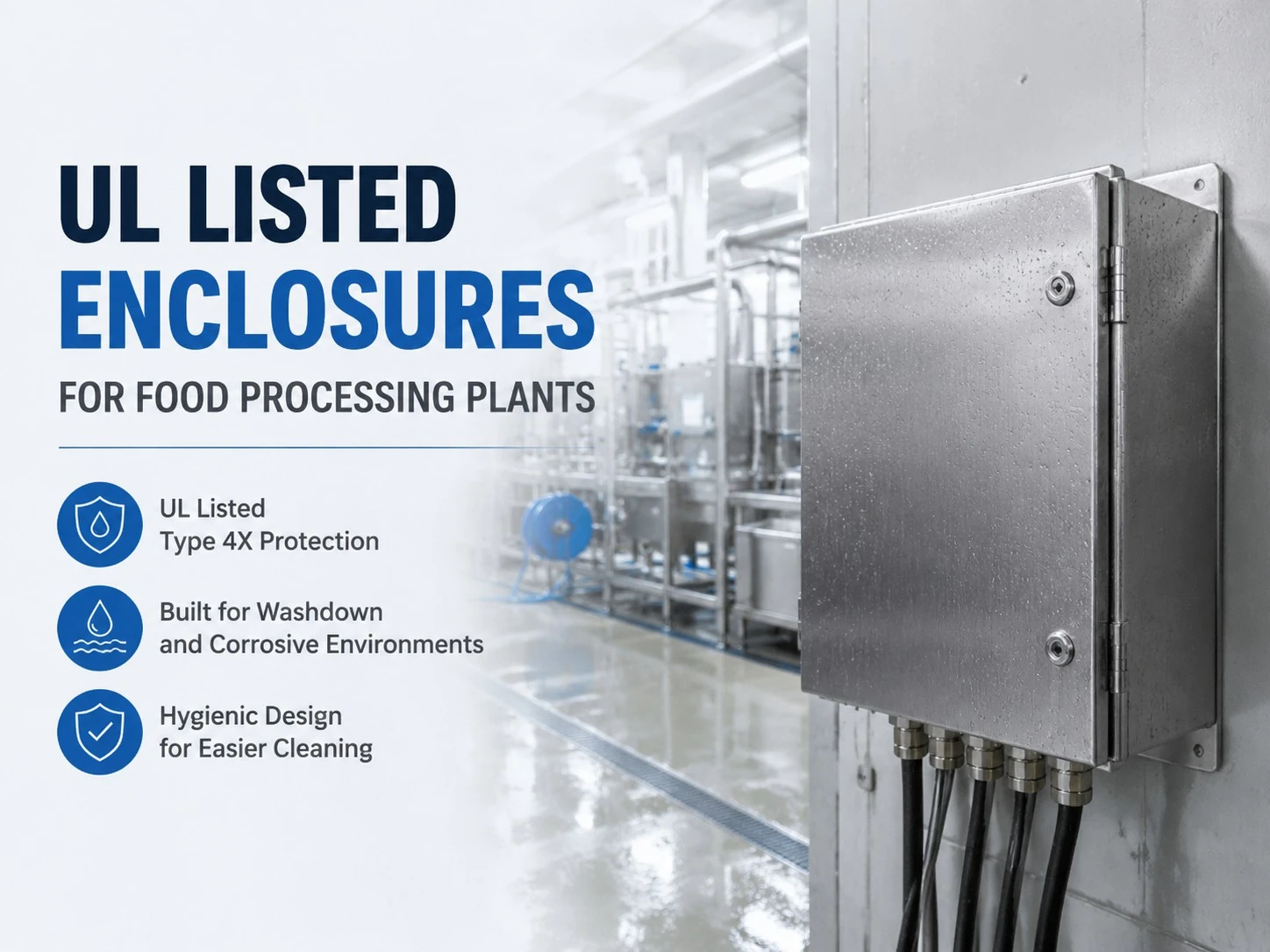
| Sanitary processing zone | Washdown and contamination | Hygienic construction | Cleanable surfaces and joints |
Comprendre les classifications NEMA et IP
NEMA enclosure Types are widely used in North American specifications to describe protection against defined environmental conditions. NEMA publishes the standards but does not certify, test, or inspect products, so buyers should verify any third-party certification or marking required by the project.
Le IEC 60529 IP Code classifies degrees of protection provided by electrical enclosures against access and the ingress of solids and liquids. NEMA Types and IP ratings overlap in some ingress-protection areas, but they evaluate different requirements and should not be treated as direct equivalents. The differences become especially important when specifying NEMA vs IP ratings for PLC enclosures.
Ratings such as NEMA Type 12, Type 4, Type 4X, IP54, IP65, or IP66 should be selected from the actual installation exposure and target-market requirements—not from a simple conversion table or the industry name alone.

Choose Material for the Real Exposure
Painted carbon or mild steel works well in many indoor industrial environments where serious corrosion is not expected.
Stainless steel is often selected where moisture, repeated cleaning, or corrosive exposure is more important. 304 stainless steel is common in industrial enclosures, while 316 or 316L may be more appropriate where chloride-rich or more aggressive chemical conditions justify greater corrosion resistance.
Avoid selecting material from a simple rule such as “washdown means 304” or “corrosion means 316.” Cleaning chemicals, chlorides, humidity, temperature, and process exposure should guide the decision.
Material alone also does not establish a NEMA Type or IP rating. Doors, seams, gaskets, hardware, openings, and overall construction affect the performance of the finished enclosure.
Hygienic Design Requires More Than Water Resistance
Food, beverage, pharmaceutical, and other sanitary lines may require more than a high ingress-protection rating.
Smooth, cleanable surfaces, suitable seals, fewer dirt traps, sloped or self-draining surfaces, and appropriate joints can make washdown more effective. Commercial hygienic enclosure designs use these features specifically to reduce areas where water or contaminants can collect.
A cabinet may resist water ingress yet still be poorly suited to a hygienic area if its construction makes residues difficult to remove.
Consider Impact and Vibration
Enclosures installed near forklifts, carts, conveyors, robots, or moving equipment can also face mechanical damage.
IEC 62262:2002+A1:2021 provides the IK classification framework for degrees of protection against external mechanical impacts.
An IK rating is not necessary for every application, but mounting strength, hinges, door hardware, vibration, and realistic impact risks should be reviewed in exposed areas.
Check the Rating After Cutouts and Accessories Are Added
A rated empty enclosure does not automatically retain the same protection after fabrication.
HMIs, pushbuttons, indicator lights, fans, filters, presse-étoupes, connectors, viewing windows, and other through-wall devices become part of the enclosure boundary.
UL 50 and UL 50E address enclosure construction and environmental considerations. UL also evaluates accessoires de boîtier résistants aux intempéries for factors such as corrosion resistance, material degradation, and their ability to maintain the environmental seal when installed on a suitably rated enclosure.
For buyers, the useful requirement is therefore:
Verify the required protection of the completed assembly, not only the empty enclosure.

Manage Heat, Condensation, EMC, and Internal Layout
Environmental sealing protects equipment from outside exposure, but the conditions created inside the cabinet are equally important.
Size Thermal Management Around the Heat Load
VFDs, servo drives, power supplies, transformers, and other power electronics release heat during operation.
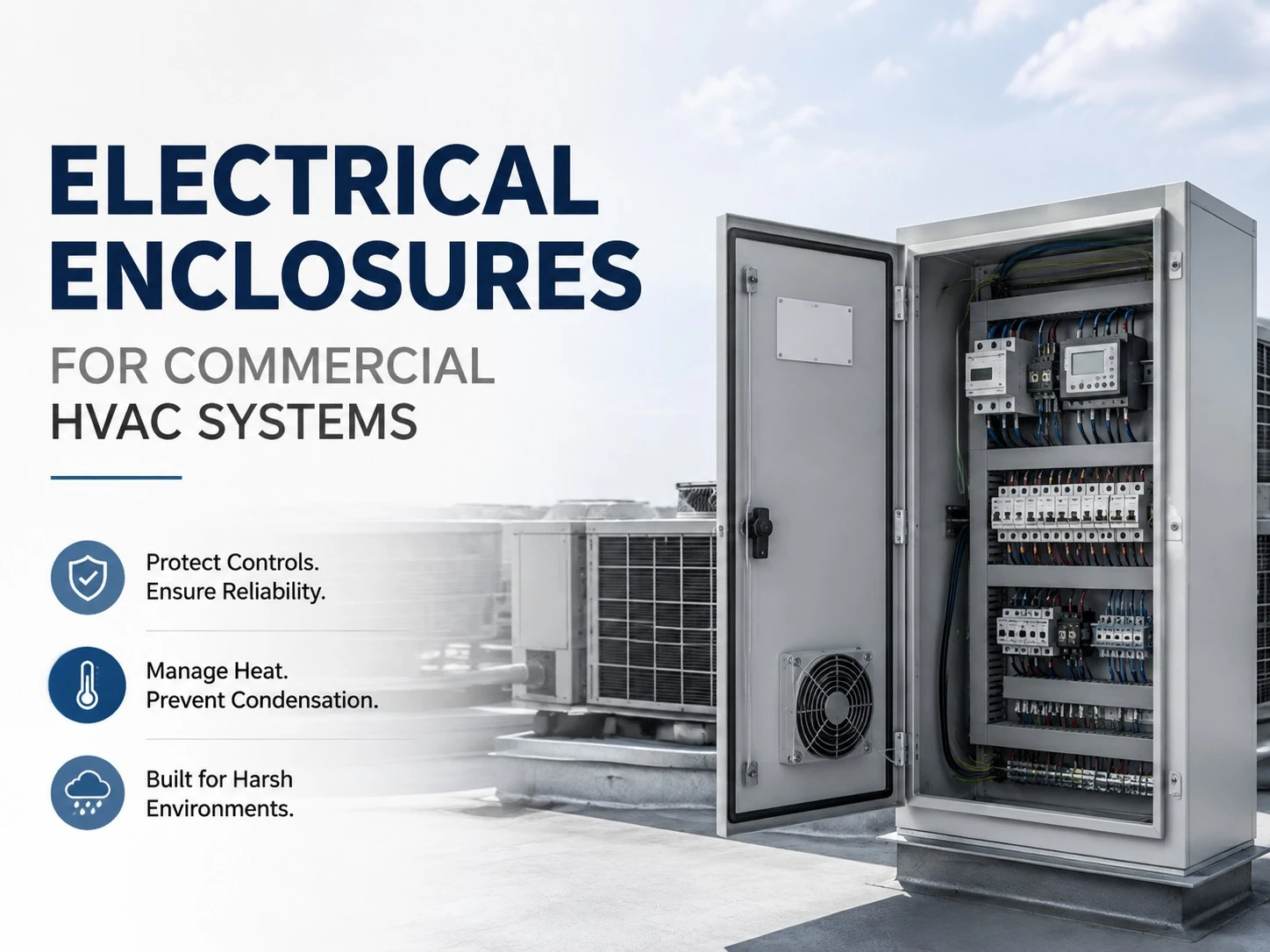
A more tightly sealed cabinet can reduce contamination while limiting heat exchange with the surrounding air. Thermal design should therefore consider equipment heat dissipation, ambient temperature, enclosure dimensions, available surface area, and the allowable operating temperature of installed components. Enclosure climate-control sizing tools likewise use factors such as ambient conditions and internal heat dissipation when selecting cooling capacity.
Depending on the application, cooling may use natural heat dissipation, filtered ventilation, air-to-air heat exchangers, or enclosure air conditioning. Ambient-air cooling is most suitable when the surrounding air is clean enough and cooler than the required internal enclosure temperature.
The important sequence is to determine the heat load and environment first, then select the climate-control method. For cabinets with concentrated drives and control electronics, the same principle is covered in more detail in this guide to Gestion thermique dans les armoires PLC.
Do Not Ignore Condensation
An enclosure can prevent external water from entering and still develop moisture internally.
Condensation becomes a concern where humidity is high or cabinet temperature falls below the dew point, including some washdown areas, cold production zones, outdoor installations, and applications with large temperature changes. Enclosure heaters and humidity-control devices are commonly used to reduce this risk.
Heating, humidity control, ventilation, or climate monitoring may be needed where condensation risk is significant.
Arrange Components for Cooling and Service
Cabinet layout should not be treated as a packing exercise.
Heat-producing devices need appropriate airflow and installation clearance. PLCs, communication hardware, power devices, protective equipment, and terminals also need practical access for wiring, adjustment, inspection, and replacement.
Manufacturer instructions for mounting orientation, spacing, temperature limits, and ventilation should remain part of the final layout.
A cabinet that technically holds every component but blocks cooling paths or makes terminals difficult to reach is effectively undersized.
Manage EMC Through Layout and Wiring
VFDs, servo drives, contactors, switching equipment, communication devices, and low-level control circuits can share the same cabinet.
Power and signal routing, shielding, grounding and bonding, cable termination, and component placement should therefore be considered during layout rather than corrected after wiring is complete. Drive manufacturers specifically address shielding, grounding, and cable termination as part of EMC control.

Design for Maintenance, Uptime, and Future Expansion
Enclosure design continues to affect production after commissioning. Maintenance access and room for planned changes can be as important as the initial installation.
Make Routine Service Practical
Technicians should be able to reach terminals, breakers, drives, PLC modules, power supplies, filters, and communication equipment without removing unrelated components.
Clear labels, organized wiring, practical door openings, accessible terminals, suitable component spacing, and serviceable filters can reduce troubleshooting and replacement time.
The goal is not maximum empty space. It is enough working room for realistic maintenance tasks.
Allow for Future Line Changes
Production lines often gain sensors, vision equipment, remote I/O, additional drives, network devices, or new machine stations over time.
Future planning should therefore consider mounting area, DIN-rail capacity, wireways, terminal space, cable entries, power distribution, cooling capacity, and the possibility of adding cabinet sections.
There is no universal spare-space percentage that fits every automation project. Reserve capacity should reflect the expected life and likely development of the line.
Standardize Where It Helps
Using common enclosure platforms, locks, filters, glands, and hardware across a plant can simplify spare-parts management and maintenance.
Standardization should not, however, force one environmental specification onto every area.
A useful principle is:
Standardize the platform where practical; customize protection for the installation environment.
For production lines where downtime is especially costly, temperature, humidity, and climate-control status can also be monitored so developing enclosure conditions are identified before they become equipment problems. Industrial enclosure suppliers now offer climate-control and monitoring systems specifically for these conditions.
Understand the Standards Before You Specify
NEMA, IP, UL 508A, NFPA 79, and SCCR do not describe the same requirement. Keeping their roles separate prevents misleading specifications.
Enclosure Standards and Environmental Protection
At the enclosure level, UL 50 addresses non-environmental construction considerations, while UL 50E addresses environmental Type-rating requirements. IEC 62208:2023 applies to empty enclosures supplied before low-voltage switchgear and controlgear components are incorporated.
NEMA and IP selection has already been covered above. The key point here is scope: compliance or ratings for an empty enclosure do not by themselves establish compliance for the completed industrial control panel or machine.
UL 508A Applies to Industrial Control Panels
UL 508A is the Standard for Industrial Control Panels. It should not be described simply as an enclosure standard. UL provides detailed guidance on UL 508A industrial control panel requirements, including panel construction, ratings, markings, component use, and SCCR.
A buyer purchasing a customized empty enclosure therefore has a different compliance scope from a buyer purchasing a complete wired industrial control panel.
Machinery Requirements Go Beyond the Cabinet
For U.S. industrial machinery, NFPA 79:2024 addresses electrical requirements at the machinery level rather than only the enclosure, while IEC 60204-1:2016+A1:2021 provides a machinery-level framework for many IEC-based projects.
Their scope extends beyond the enclosure itself. Requirements can affect machine supply disconnecting means, access to live parts, grounding and bonding, wiring, and enclosure interlocking. If these functions are part of the cabinet, they should be considered before the enclosure is sized or machined.
Selecting a suitable enclosure alone does not establish compliance for the complete machine.
Keep SCCR Separate From Environmental Protection
Short-circuit current rating addresses electrical fault capability rather than dust, water, or corrosion protection.
NEC Article 409 covers industrial control panels, and UL states that Article 409 requires industrial control panels to be marked with an SCCR. UL 508A Supplement SB provides an accepted method for determining the SCCR of the control panel.
That creates an important distinction:
A high NEMA or IP rating does not establish an adequate SCCR.
Projects involving classified hazardous locations, combustible dust, flammable gases, or other special hazards can require additional equipment and rules beyond ordinary industrial enclosure selection.

What Should Buyers Specify to an Enclosure Manufacturer?
A useful enclosure RFQ describes the application, not just the outside dimensions and IP rating.
- Installation environment: Provide dust, water, oil, chemicals, humidity, temperature, corrosion, vibration, and impact conditions.
- Location on the line: Identify whether the enclosure is in an electrical room, beside machinery, at an operator station, in a washdown area, outdoors, or in another defined zone.
- Required environmental protection: State the required NEMA Type, IP rating, customer specification, or performance requirement.
- Enclosure architecture and dimensions: Define wall-mounted, floor-standing, modular, bayed, or other construction, together with dimensional and installation limits.
- Internal equipment and heat load: List important PLCs, VFDs, servo drives, power supplies, protective devices, networking equipment, and significant heat-producing components.
- Cutouts, cable entries, and disconnect interfaces: Define HMIs, pushbuttons, windows, fans, cable glands, connectors, conduit entries, and, where applicable, main disconnect handles, flanges, or door-interlock provisions.
- Materials and compliance requirements: State the material, finish, corrosion exposure, destination market, and required enclosure, control-panel, or machinery standards. For a complete control panel, specify certification and SCCR requirements separately from the enclosure rating.
- Internal provisions and future capacity: Provide drawings where available and define mounting plates, DIN rails, wireways, grounding or bonding provisions, spare terminal and mounting capacity, expected expansion, quantities, and other customization requirements.
This information also helps distinguish two different purchasing scopes: a customized enclosure and a complete wired industrial control panel. The enclosure provides the mechanical and environmental platform; a finished panel adds installed electrical components, wiring, ratings, labeling, testing, and project-specific compliance requirements.
For projects requiring customized dimensions, materials, machining, internal mounting layouts, or protection levels, Eabel can develop electrical enclosures around the actual conditions of the production line. Modular enclosure systems can also support projects where cabinet configuration or future expansion is expected to change.

FAQs About Electrical Enclosures for Automated Production Lines
Conclusion

Electrical enclosures for automated production lines should be selected around the real conditions of each installation zone. Environmental exposure, internal heat, condensation, component layout, maintenance access, final cutouts, applicable standards, and future expansion all affect whether a cabinet will support reliable operation.
The goal is not to specify the highest rating or most expensive material. It is to build an enclosure solution that protects the installed equipment without creating avoidable thermal, service, compliance, or expansion problems.
If you are designing or upgrading an automated production line, contacter Eabel with your installation environment, required protection level, cabinet dimensions, internal equipment, heat load, cutouts, drawings, target-market requirements, and expected quantity. Eabel can help evaluate enclosure structure, materials, machining, internal configuration, thermal-management provisions, and customization requirements for your project.
Lectures connexes
Essential Components for Industrial Control Panels
Guide des armoires PLC : types, disposition, câblage et composants
Accessoires pour boîtiers électriques : types, normes et guide de sélection
Comment éviter la condensation dans les enceintes
Sélection des matériaux appropriés pour les boîtiers industriels



 FR
FR  EN
EN  ES
ES  AR
AR  JA
JA  KO
KO  RU
RU  DE
DE  PT
PT  IT
IT  ZH
ZH  TH
TH  VI
VI  HI
HI  MS
MS 