

Assess the Coastal or Marine Exposure First
Salt is a major concern near the sea because chloride deposits can promote localized corrosion when moisture is present. Coastal enclosures may also face high humidity, condensation, rain, UV exposure, temperature cycling, and wind-driven spray. Crevices can retain salt and moisture, while unsuitable combinations of dissimilar metals can increase galvanic corrosion risk.
The severity varies greatly by location. A cabinet inside a protected coastal building does not face the same conditions as a dockside panel or equipment installed on an exposed vessel deck.

Sheltered Coastal Locations
Indoor electrical rooms and covered outdoor installations may avoid direct spray but still receive salt-laden air. Humidity, condensation, and long periods of surface dampness can become more important than direct water impact.
The goal is not automatically to specify the most expensive material. First determine how much salt reaches the equipment, how long surfaces remain wet, and how often temperature changes can create condensation.
Exposed Coastal Locations
Outdoor enclosures at ports, waterfront plants, utilities, rooftops, and coastal infrastructure can receive salt deposits together with rain, sunlight, and wind-driven moisture.
Distance from the shoreline alone is a poor selection rule. ISO 9223 identifies temperature-humidity conditions, airborne salinity, and sulfur dioxide pollution as key factors in atmospheric corrosivity.
For that reason, rules such as “use 316L within one mile of the coast” are too simple for a serious project specification. Site orientation, sheltering, prevailing winds, and actual salt deposition can produce different exposure levels at similar distances from the sea.
Splash, Washdown, and Flood-Prone Areas
Marinas, docks, desalination facilities, and waterfront process areas may expose enclosures to direct spray or washdown. Some installations also face temporary flooding.
Here, water ingress becomes a larger design requirement, but immersion resistance and corrosion resistance should still be evaluated separately. Passing an immersion test does not by itself prove long-term resistance to a chloride-rich atmosphere.
Shipboard and Offshore Exposure
Ships and offshore facilities add vibration, vessel movement, direct weather exposure, and project-specific compliance requirements. A NEMA Type or IP Code alone does not establish that an enclosure is suitable or approved for shipboard service.
Within the scope of 46 CFR Part 111, U.S. vessel electrical requirements address enclosure protection, corrosion-resistant materials or finishes, equipment temperature, vessel inclination, grounding, and other installation conditions.
The practical rule is simple: define the environment before selecting the enclosure. “Marine grade” is a description, not a complete engineering specification.
NEMA, IP, and Corrosion Tests: What Do They Prove?
NEMA Types, IP Codes, and corrosion tests are often listed together, but they evaluate different aspects of enclosure performance. Treating them as interchangeable can leave an important risk unaddressed.
NEMA 4X, 6, and 6P
NEMA Type 4X provides protection against water exposure and includes corrosion protection, making it relevant to many coastal and corrosive outdoor installations. NEMA 250 specifically includes Type 4X among the enclosure Types subject to its corrosion-protection requirements.
Type 6 addresses temporary submersion, while Type 6P addresses prolonged submersion and also falls within the corrosion-protection provisions of NEMA 250. These Type numbers are not a simple performance ladder: Type 6 should not be treated as a corrosion upgrade from Type 4X.
For flood-prone projects, specify the required immersion conditions and corrosion protection separately instead of choosing a higher Type number by default.

IP66, IP67, and IP68
CEI 60529 classifies the degree of protection an enclosure provides against solid foreign objects and water ingress.
IP66 is relevant where dust-tight construction and protection against powerful water jets are required. IP67 and IP68 address immersion conditions, with IP68 intended for continuous immersion under specified conditions. Buyers should check the conditions attached to the actual product rating rather than interpreting IP68 as unlimited depth or unlimited immersion time.
Most importantly:
An IP rating is not a corrosion-resistance rating.
Two IP66 enclosures can satisfy the same ingress requirement yet perform very differently after years of salt exposure because their materials, finishes, hardware, seals, and fabrication differ.
NEMA Types and IP Codes should therefore not be treated as simple one-to-one equivalents. For a broader comparison, see our guide to Indices de protection NEMA et IP.
What Salt-Spray Testing Really Means
ASTM B117 provides a controlled salt-spray environment for comparing the relative corrosion resistance of specimens. ASTM cautions that stand-alone salt-spray results have seldom correlated reliably with performance in natural environments.
A claim such as “1,000 salt-spray hours equals 20 years beside the ocean” should therefore not be accepted without separate evidence supporting that relationship.
IEC 60068-2-52 cyclic salt-mist testing is another relevant method for components or equipment designed to withstand salt-laden atmospheres.
For useful procurement evidence, confirm the test method, duration, specimen or assembly tested, surface preparation, acceptance criteria, and whether the tested construction matches the product being supplied.
Which Enclosure Material Works Best Near Saltwater?
There is no single best material for every coastal electrical enclosure. Selection should reflect chloride severity, enclosure size, mechanical requirements, maintenance access, heat load, expected service life, and cost.
Acier inoxydable 316 et 316L
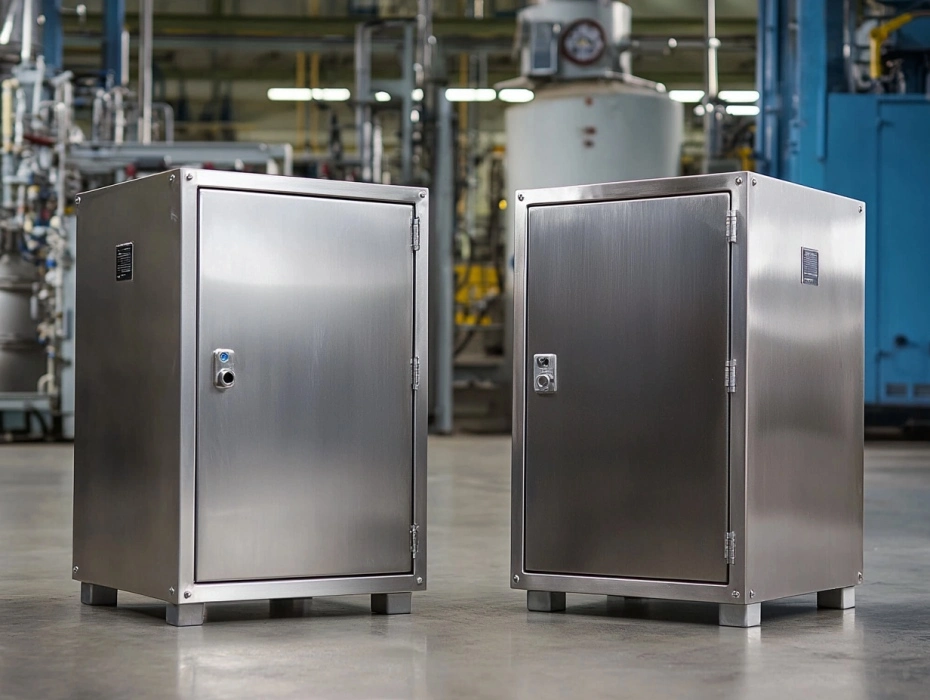
316 and 316L are strong choices for many aggressive coastal environments. Their molybdenum content improves resistance to localized corrosion such as pitting and crevice corrosion compared with stainless grades without comparable molybdenum additions. They are still not corrosion-proof. For a deeper material comparison, see our guide to Boîtiers en acier inoxydable 304 vs 316.
The “L” in 316L denotes lower carbon content, which improves resistance to intergranular corrosion after welding. It should not be interpreted as meaning that 316L is inherently seawater-proof.
Fabrication can still reduce corrosion performance. Weld heat tint, embedded iron, and other surface contamination should be addressed through appropriate cleaning and finishing. ASTM A380/A380M-25 covers cleaning, descaling, pickling, and passivation practices for stainless steel parts, equipment, and systems.
For welded marine enclosures, ask both “Is it 316L?” and “How are the welds and fabricated surfaces cleaned and finished?”
Aluminium
Aluminum combines low weight, corrosion resistance, and good thermal conductivity. It can be useful for larger cabinets, weight-sensitive installations, and applications where heat transfer is important.
However, “marine-grade aluminum” is not a sufficient specification. Buyers should confirm the actual alloy, pretreatment, coating or finish, and compatibility with fasteners, hinges, mounting hardware, and nearby metals.
Dissimilar-metal contact deserves particular attention in wet, salty environments because an unfavorable galvanic couple can accelerate localized corrosion.
Fiberglass and Polycarbonate
Fiberglass-reinforced and polycarbonate enclosures do not rust like carbon steel and are lightweight and electrically non-conductive.
They can work well for junction boxes, instrumentation, communication equipment, and distributed controls, but they have different design limits. Buyers should verify UV resistance, operating temperature, impact strength, fire performance, structural stiffness, and any EMI shielding requirement.
A non-metallic enclosure may resist salt exposure well while still being unsuitable for a large cabinet or a mechanically demanding installation.
Acier au carbone revêtu
Coated carbon steel can remain a practical option for sheltered or lower-severity coastal locations when the coating system and surface preparation are appropriate.
Its main weakness is damage tolerance. Scratches, poorly protected cut edges, or coating breakdown can expose the steel substrate and create corrosion sites.
For this reason, compare lifecycle cost rather than purchase price alone. Maintenance access, coating repair, downtime, replacement difficulty, and required service life can change which material is most economical.
Design the Complete Enclosure, Not Just the Box
The enclosure body is only one part of coastal protection. A 316L cabinet fitted with unsuitable fasteners, a poorly selected gasket, or an unprotected cable entry can still fail early.
UL evaluates enclosure accessories such as hinges, latches, windows, filter-fan kits, hole plugs, air conditioners, heat exchangers, and sealing devices for factors that can include corrosion resistance, UV degradation, gasket performance, and their ability to maintain the intended Type or IP rating when installed.
This supports an important purchasing rule:
The rating of an empty enclosure does not automatically apply to the completed assembly.
Cutouts, controls, vents, cooling equipment, and other accessories must be selected and installed so the finished system maintains the required environmental protection. Cable entries deserve particular attention because incorrectly selected or installed presse-étoupes can become a weak point in an otherwise well-protected enclosure.
Crevices, poorly drained surfaces, exposed seams, and incompatible metal combinations should also be minimized because they can trap salt or create localized corrosion.
Control Condensation Without Pulling Salt Inside
A sealed enclosure is not automatically condensation-free.
Humid air can become trapped inside, while changes in ambient temperature can bring internal surfaces below the dew point. Equipment heat and solar gain add another thermal challenge. The right approach to moisture and condensation management in electrical enclosures depends on the temperature cycle, internal heat load, humidity, and how tightly the enclosure must remain sealed.
Depending on the project, the solution may include pressure-equalization devices, anti-condensation heaters, sun shields, heat exchangers, or closed-loop enclosure air conditioners.
Open-loop filtered fans need particular care in severe coastal environments. They may reduce internal temperature while continuously drawing salt-laden humid air into the cabinet. Where contaminants must remain outside, thermal management should be designed together with the sealing strategy.
The same tradeoff appears in shipboard design. Within the scope of 46 CFR Part 111, enclosures used where exceptional protection is required must also be designed so the total rated temperature of the equipment inside is not exceeded.
How to Specify a Coastal or Marine Electrical Enclosure
A good RFQ should describe the installation environment before listing a preferred material. This gives the supplier enough information to match the complete enclosure design to the actual risks.
| Installation Condition | Main Design Priority | What the Buyer Should Verify |
|---|---|---|
| Sheltered coastal | Humidity, airborne salt, condensation | Material or coating, gasket system, thermal control, required environmental rating |
| Exposed coastal | Salt, rain, UV, wind-driven moisture | Corrosion strategy, NEMA/IP requirements, UV resistance, hardware and fasteners |
| Splash or washdown | Direct water plus chloride exposure | Seals, glands, drainage, ingress rating, material and corrosion qualification |
| Flood or immersion risk | Defined submersion exposure | Required depth and duration plus separate corrosion requirements |
| Shipboard or offshore | Marine exposure plus project-specific compliance | Ingress, corrosion, temperature, vibration, grounding, accessories and approvals |
The table is a selection framework, not a substitute for project-specific engineering. Shipboard requirements depend on vessel type, equipment location, applicable regulations, classification rules, and the project specification.
Within the scope of 46 CFR Part 111, equipment in locations requiring exceptional protection must meet the applicable enclosure requirements, while enclosures and electrical parts that can be damaged by corrosion must use corrosion-resistant materials or finishes. A NEMA 4X or IP66 rating alone is therefore not proof of shipboard approval.
Once these requirements are clear, buyers can compare suitable enclosure platforms rather than shopping by material or rating alone. Eabel’s electrical enclosure range includes industrial and outdoor enclosure options across multiple sizes and configurations. Use the exposure, material, thermal, and finished-assembly requirements above to narrow the options for your project.
Before requesting a final quotation, give the supplier a clear project specification:
- installation location and exposure to salt, rain, spray, washdown, or immersion;
- required NEMA Type and/or IP Code;
- enclosure material, exact alloy where required, and surface finish or coating;
- ambient temperature, solar exposure, internal heat load, and condensation-control needs;
- cable entries, windows, controls, glands, vents, connectors, and cooling equipment;
- required corrosion or salt-mist testing and acceptance criteria;
- applicable electrical, marine, hazardous-location, or project approvals;
- dimensions, mounting method, internal equipment, access requirements, and order quantity.
When comparing suppliers, clarify two points that generic quotations often leave vague. Ask exactly what “marine grade” means in terms of alloy or base material, surface treatment, hardware, sealing, environmental ratings, and corrosion qualification. Then confirm whether the completed assembly retains the required protection after every cutout, gland, control, vent, and cooling accessory is installed.
This avoids approving a well-rated empty enclosure whose protection is later reduced during customization.
Plan Maintenance Around the Exposure
Even a correctly specified coastal enclosure needs inspection.
The interval should reflect exposure severity, equipment criticality, accessibility, and observed salt accumulation rather than a fixed schedule for every site.
Inspect for salt buildup, coating damage, rust staining, deteriorated gaskets, loose hardware, damaged cable entries, water tracks, condensation, and blocked drainage or pressure-equalization devices.
Cleaning should remove deposits without damaging coatings, stainless surfaces, seals, or enclosure accessories. Early repair of damaged finishes and seals is generally easier than dealing with corrosion or moisture after it reaches the electrical equipment.

FAQs About Electrical Enclosures for Coastal and Marine Environments
Conclusion
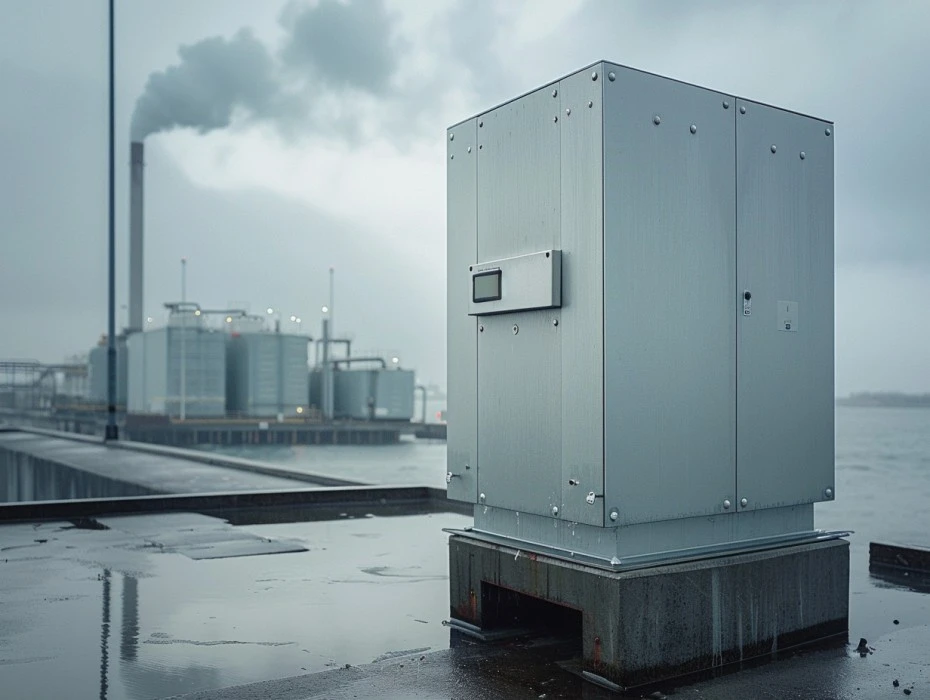
The best electrical enclosure for a coastal or marine environment is not simply the one with the highest IP rating or the most expensive material. Reliable protection comes from matching the real exposure with the required ingress protection, corrosion strategy, material, fabrication quality, hardware, sealing, thermal management, testing, and applicable project requirements.
For a coastal, port, marina, shipboard, or offshore project, contacter Eabel with your installation environment, required NEMA or IP rating, enclosure dimensions, internal equipment, heat load, material preference, certification requirements, and order quantity. A clear specification makes it easier to develop an enclosure that protects the electrical system without unnecessary cost or overspecification.
Lectures connexes
Sélection des matériaux appropriés pour les boîtiers industriels
How to Prevent Rust in Electrical Enclosures
Fiberglass vs Stainless Steel Enclosures Guide
NEMA 4X vs NEMA 6P: Choosing the Right Enclosure
Nettoyage et entretien des boîtiers électriques : Guide des bonnes pratiques
Coffrets électriques pour environnements difficiles : ce que vous devez savoir



 FR
FR  EN
EN  ES
ES  AR
AR  JA
JA  KO
KO  RU
RU  DE
DE  PT
PT  IT
IT  ZH
ZH  TH
TH  VI
VI  HI
HI  MS
MS 