

What UL Certification Covers: Enclosure vs. Complete Assembly
One of the easiest specification mistakes is asking whether an enclosure is “UL approved” without defining what has actually been evaluated.
For hospital projects, the distinction between the enclosure and the finished electrical equipment matters.
UL 50 y UL 50E
UL 50 covers non-environmental construction and performance requirements for electrical enclosures, including protection against incidental contact with enclosed equipment. UL 50E adds environmental construction and performance requirements and is intended to be used with UL 50 or the applicable end-product standard.
UL 50E covers indoor Types 1, 2, 5, 12, 12K, and 13, as well as indoor or outdoor Types 3, 3X, 3R, 3RX, 3S, 3SX, 4, 4X, 6, and 6P. The required Type depends on the environmental protection needed at the actual installation location.
That rating applies to the enclosure within the scope of the standard. It does not mean that electrical equipment later installed inside it becomes certified automatically.
For example, placing breakers, relays, PLCs, terminals, or disconnects inside a certified enclosure does not by itself create a UL-certified control panel. Buyers who need more detail on enclosure-level certification can review this guide to Cajas con certificación UL.
NEMA Type terminology is also common in enclosure specifications, but a NEMA Type claim should not be confused with UL product certification. NEMA develops enclosure classifications and standards; it does not itself certify, test, or inspect products for compliance.

Bare Enclosure vs. Finished Electrical Equipment
It helps to separate the purchasing process into three levels.
A bare enclosure provides the housing, mounting structure, and specified environmental protection.
A populated enclosure adds electrical components, wiring, cable entries, thermal devices, and other features. These additions introduce requirements beyond the original enclosure construction.
A finished electrical assembly is evaluated according to its actual function. A panelboard, switchboard, transfer switch, industrial control panel, and isolated power system are different equipment categories and can require different product standards.
That leads to a better procurement question:
What exactly is certified—the empty enclosure, an installed component, or the complete electrical assembly being supplied?
The same principle applies to modifications. UL evaluates environmental-rated enclosure accessories such as cable-sealing devices, filter fans, air conditioners, heat exchangers, windows, and other accessories for their ability to maintain specified environmental ratings when installed as evaluated.
Drilling holes or adding accessories should therefore never be assumed to preserve the original rating or certification.
Which UL and Healthcare Electrical Standards Apply?
There is no single “hospital electrical enclosure standard.” The applicable product standard follows the function of the finished equipment.
Hospitals may also have installation-code, healthcare-safety, project, and AHJ requirements. These requirements work together, but they should not be treated as interchangeable.
UL 50 and UL 50E: Electrical Enclosures
UL 50 and UL 50E are the key references when the question concerns the enclosure itself.
The October 2025 revision of UL 50E added ancillary power-wash ratings, including the XH corrosion-resistant hose-down rating, and clarified requirements involving stainless steel and sealing. These updates matter where actual cleaning or hose-down exposure justifies them; they are not universal requirements for healthcare facilities.
UL 50E applies to enclosures used in non-hazardous locations. If a healthcare project includes a hazardous (classified) location, the equipment must be evaluated for the applicable hazardous-location requirements rather than relying on an enclosure Type rating alone.
UL 67: Panelboards
When the finished product is a panelboard, UL 67 applies to the completed panelboard rather than the enclosure alone.
The current 14th edition of UL 67 was published on July 31, 2026.
UL 891 and UL 1008: Distribution and Transfer Equipment
UL 891 applies to dead-front switchboards within its scope.
If the hospital distribution system uses metal-enclosed low-voltage power circuit breaker switchgear instead of a switchboard, UL 1558 may apply to that finished equipment category.
Hospital essential electrical systems may also include transfer switch equipment. UL 1008 covers several categories of transfer switches rated up to 1,000 V for use in nonhazardous locations within its scope.
The important purchasing principle is the same: the applicable product standard follows the finished equipment function, not simply the fact that it serves a hospital.
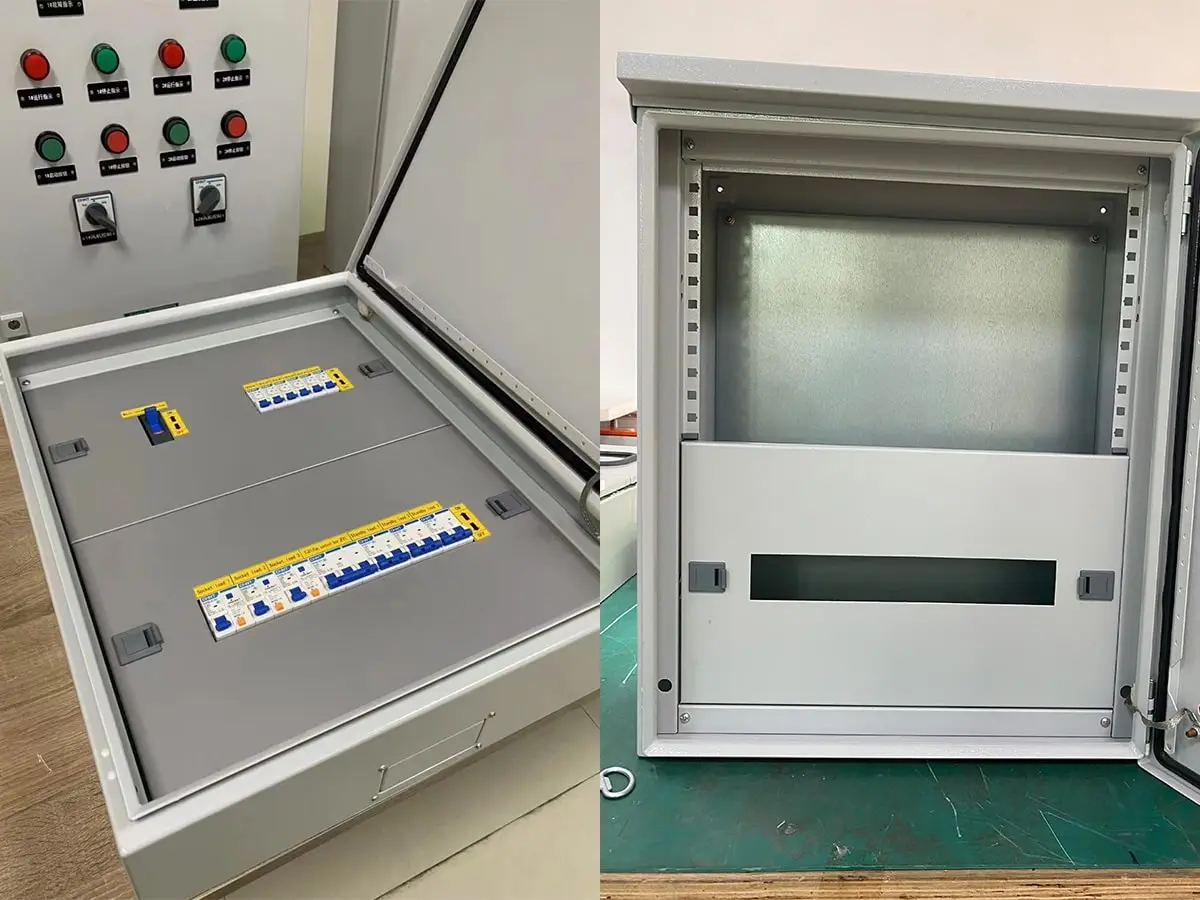
UL 508A: Industrial Control Panels
UL 508A becomes relevant when the finished equipment is an industrial control panel.
Its scope covers industrial control panel assemblies while directing equipment that belongs to other product categories—such as panelboards and switchboards—to their applicable standards.
For applicable control panels, buyers should consider the SCCR of the finished assembly, not ask for an “enclosure SCCR.” The short-circuit current rating must be appropriate for the completed equipment and installation.
UL 1047: Isolated Power Systems Equipment
UL 1047 covers isolated power systems equipment within its scope for healthcare facilities, including isolated power centers and isolated power panelboards associated with installations under NEC Article 517 and NFPA 99.
The current seventh edition was published in March 2025, with changes primarily editorial rather than a major shift in technical requirements.
This standard applies to the isolated power equipment it covers—not to every enclosure installed in an operating or procedure area.
NEC Article 517 and NFPA 99
Product certification is only one part of a healthcare electrical project.
NEC Article 517 addresses electrical installations in healthcare facilities, while NFPA 99 addresses healthcare facility safety through a risk-based framework. The two documents work together in healthcare electrical safety rather than serving the same purpose.
Neither should be interpreted as saying that more clinically critical equipment automatically needs a higher enclosure Type.
Projects must also follow the NEC edition adopted by the applicable jurisdiction. Multiple NEC editions remain in effect across the United States, so specifications should refer to the locally adopted code and AHJ requirements rather than simply “the latest NEC.”
Does UL 60601-1 Apply?
Not simply because an enclosure is installed in a hospital.
The IEC/UL 60601 family addresses the basic safety and essential performance of medical electrical equipment and systems. Facility panelboards, switchboards, transfer equipment, and general electrical control equipment follow the standards applicable to their own product categories.
This distinction prevents a common mistake: treating everything electrical inside a medical building as medical electrical equipment.
How to Choose an Electrical Enclosure by Hospital Area
The word “hospital” does not determine an enclosure rating. The installation environment does.
The table below is a selection framework, not a universal code table. Final requirements depend on actual exposure, the certified equipment configuration, project specifications, and the AHJ.
| Hospital Location | Main Selection Issue | Rating Logic | Key Design Concern |
|---|---|---|---|
| Electrical rooms | Controlled indoor environment | Select for actual dust and water exposure; high washdown protection is usually unnecessary unless conditions require it | Heat, access, service clearance |
| Patient-care areas | Human contact, limited space, routine cleaning | Do not raise the environmental Type solely because the room is clinically important | Flush or recessed mounting, controlled access, cleanable surfaces |
| Operating and procedure areas | Specialized electrical-system requirements | Coordinate the enclosure with the complete electrical design and applicable healthcare requirements | Certification, access, cleaning |
| Sterile processing and wash areas | Moisture and cleaning | Evaluate actual splash, washdown, and corrosion exposure before specifying higher protection | Sealing, corrosion resistance, and rated drainage or breather provisions where needed |
| Laboratories | Chemicals, moisture, cleaning agents | Match enclosure protection and material to the actual exposure | Material and gasket compatibility |
| Mechanical rooms | Dust, dripping liquids, heat, humidity | Select indoor protection for the real conditions rather than the room name | Cooling and condensation control |
| Rooftop installations | Rain, snow, UV, temperature change | Evaluate outdoor Types such as 3R, 4, or 4X according to exposure | Weather sealing, UV resistance, corrosion |
| Outdoor utility areas | Water and corrosive conditions | Increase environmental protection when actual exposure justifies it | Sealed cable entries, corrosion resistance |
| MRI areas | Magnetic-field, RF, and equipment-specific constraints | Coordinate with MR safety and equipment requirements; enclosure Type alone is insufficient | Material, placement, RF/EMI considerations, service access |
Three distinctions make this selection process more reliable.
System Criticality and Environmental Rating Are Different
A panel feeding critical loads may be extremely important to hospital operation while still being installed in a dry, controlled electrical room.
Its system criticality affects the electrical architecture, protection, reliability, and redundancy strategy. Its enclosure Type addresses environmental exposure.
One should not be used as a substitute for the other.
Cleanability and Type Rating Are Different Requirements
A hospital may need smooth, durable surfaces that are easy to wipe down without needing hose-down protection.
Likewise, stainless steel may be desirable for cleanability or corrosion resistance without automatically establishing a particular environmental Type.
Specify cleanability, corrosion resistance, and certified Type rating separately.
Condensation Requires Separate Evaluation
UL 50E specifically excludes protection against conditions such as condensation that occur within the enclosure, as well as contamination that can enter through conduit or unsealed openings.
If condensation is credible, address it through the complete thermal design. Depending on the application, this may involve heaters, ventilation, insulation, heat exchangers, air conditioning, or drainage and breather devices suitable for electrical enclosures.
A higher Type rating by itself does not solve internal condensation.

Materials and Design Features That Matter
Once the equipment category and environment are known, material selection becomes much easier.
The best material is not automatically the most expensive one. It is the material that meets the required environmental, mechanical, maintenance, and lifecycle needs.
Acero al carbono pintado
Painted carbon steel is practical for many dry indoor electrical rooms and controlled support spaces.
It provides good mechanical strength and economical fabrication. Where corrosion exposure is limited and the required enclosure rating can be achieved, stainless steel may add cost without delivering a meaningful operational advantage.
Coating quality and fabrication still matter, especially around edges, penetrations, welds, and damaged surfaces.
Acero inoxidable 304
Acero inoxidable 304 is useful where improved corrosion resistance, moisture tolerance, or cleanability is needed, including many healthcare support spaces, laboratories, and damp indoor applications.
Where disinfectants or cleaning chemicals are used repeatedly, verify their compatibility with the enclosure finish, gaskets, seals, and exposed hardware rather than selecting material by grade alone.
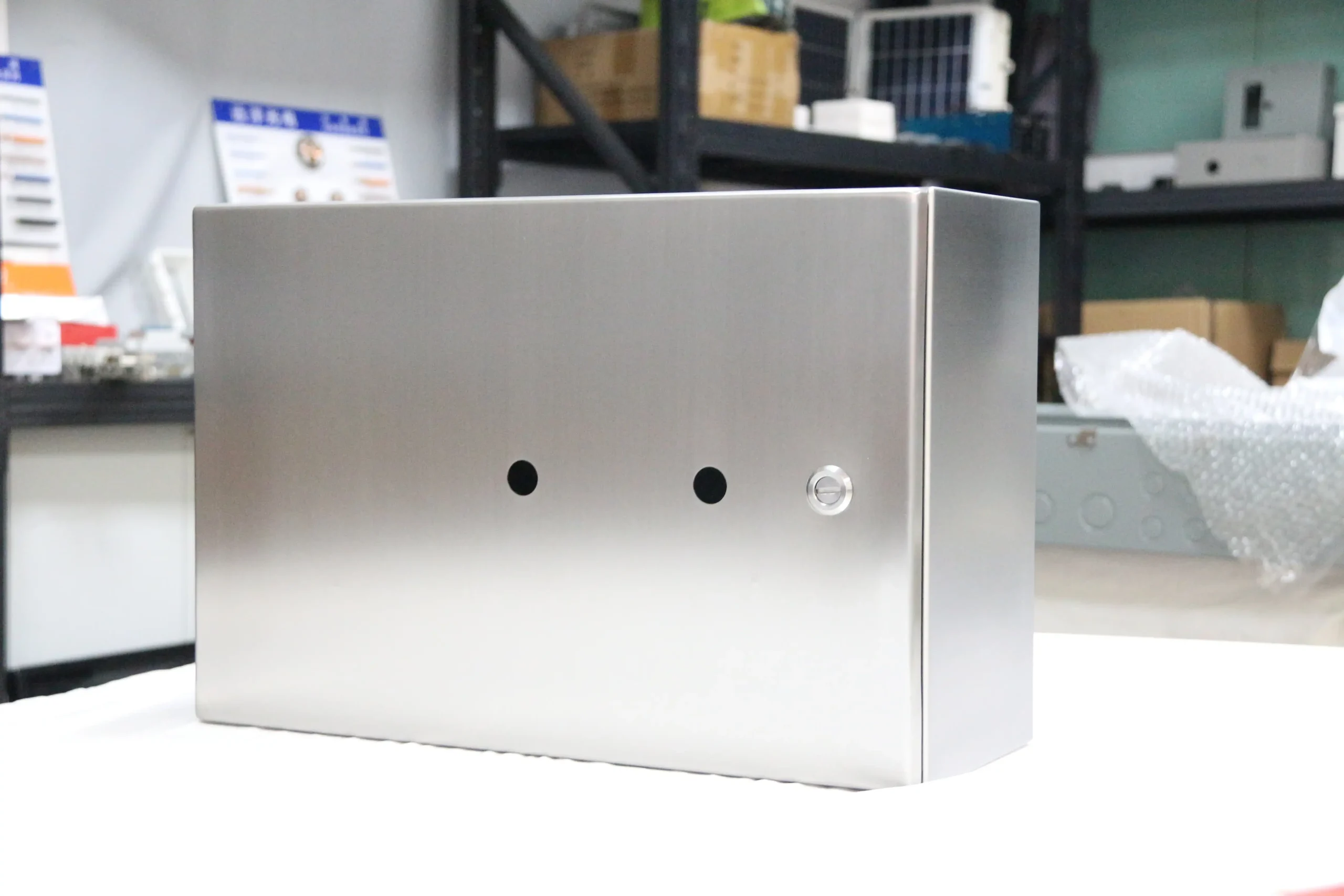
Specify the required certified Type separately; stainless steel construction alone does not establish a Type 4X rating.
Acero inoxidable 316
316 stainless steel is worth considering in more aggressive corrosive environments, including some chloride or chemical exposures.
Potential applications include coastal healthcare facilities, demanding laboratory environments, or outdoor installations exposed to corrosive conditions.
It should be specified because the environment calls for it—not simply because the project is a hospital.
Nonmetallic Enclosures
Nonmetallic enclosures can offer low weight, electrical insulation, and strong resistance to certain corrosive environments.
Their suitability depends on the complete application. Mechanical strength, flame properties, UV exposure, temperature limits, mounting, equipment grounding requirements, and finished-equipment certification still need to be evaluated.
Design Details Buyers Should Specify
Material choice alone does not make an enclosure suitable.
Door construction, hinges, gaskets, mounting, cable entries, grounding and bonding provisions, access control, internal layout, thermal management, and service clearance can have equal or greater impact on long-term performance.
For public-facing areas, flush or recessed construction can reduce protrusions and simplify routine cleaning, while locks or tool-operated access address unauthorized entry. In restricted electrical spaces, service clearance and technician access usually deserve greater priority.
Thermal equipment should also be planned before fabrication. Fans, filters, heat exchangers, or air conditioners can affect enclosure layout and environmental performance.
The same applies to inspection windows and other accessories. Integrating them into the evaluated enclosure or finished-equipment design is preferable to cutting new openings into completed equipment without checking their effect on the required rating.
Hospital Electrical Enclosure Buyer Checklist
A useful RFQ should describe the equipment and its operating conditions rather than simply request a “hospital electrical enclosure.”
Before ordering, buyers should work through the following sequence:
- Define the equipment function. Identify whether the finished product is a panelboard, switchboard, transfer switch assembly, industrial control panel, isolated power assembly, junction enclosure, monitoring cabinet, or another equipment type.
- Identify the applicable certification. Determine which product standard applies to the finished equipment, not only to its enclosure.
- Document the environment. Define indoor or outdoor installation, dust, dripping water, splashing, washdown, chemicals, humidity, UV exposure, temperature, and corrosion.
- Specify the required environmental Type. Base the requirement on actual exposure and the project specification rather than automatically selecting the highest rating.
- Choose the material. Specify painted steel, 304 stainless steel, 316 stainless steel, or an appropriate nonmetallic construction according to the service environment.
- Provide dimensions and component requirements. Include usable internal space, wiring routes, conductor bend space, clearances, component layout, and reasonable future service needs.
- Define the thermal conditions. Provide expected heat loss, ambient temperature, acceptable internal temperature, and any heating or cooling requirement.
- Plan cable and conduit entries. Define gland plates, cable glands, conduit hubs, penetrations, and entry locations before fabrication whenever possible.
- Specify mounting and access. Identify wall-mounted, recessed, flush, floor-standing, or other installation requirements together with door swing and maintenance clearance.
- Define access control. State whether the project requires locks, tools, interlocks, inspection windows, or other controlled-access features.
- Address fault current where applicable. For finished equipment such as industrial control panels, confirm the required assembly SCCR against the available fault current.
- Define documentation. Request drawings, component information, labels, wiring documentation, certification details, and project-specific submittals.
- Confirm project requirements before release. Verify the adopted code edition, healthcare requirements, project specifications, and AHJ expectations before manufacturing begins.
Verify the UL Certification, Not Just the Mark
“UL Listed” should start a verification process rather than end it.
Check the manufacturer, model or product family, product category, applicable standard, environmental Type, and certification scope. Where available, the UL file number and Category Control Number can make verification easier.
UL Product iQ supports searches using information such as company name, model number, product category or CCN, and UL file number.
The key question remains:
Does the certification cover the enclosure, an accessory, or the complete configuration being quoted?
When a Custom Hospital Enclosure Makes Sense
Standard enclosures are efficient when dimensions, mounting, component layout, cable entry, and thermal requirements are conventional.
Custom electrical enclosures become more useful when a healthcare project involves constrained retrofit spaces, recessed construction, unusual component layouts, specialized control or isolation equipment, multiple cable-entry zones, high heat loads, restricted-access requirements, or project-specific mounting geometry.
For buyers who have already defined the required certification, Type rating, material, and installation constraints, Eabel’s standard and custom electrical enclosures provide a starting point for comparing wall-mounted, free-standing, and modular configurations. The final enclosure should still be engineered around the project-specific equipment, environment, and certification requirements.
The certification strategy should be defined before custom fabrication begins. Designing an arbitrary enclosure first and trying to resolve certification afterward can create avoidable redesign and testing work.
Common Specification Mistakes to Avoid
Over-specifying environmental protection: Do not default to Type 4X simply because the project is a hospital or the enclosure is stainless steel. Select the certified Type and material separately from the actual exposure.
Confusing enclosure and finished-equipment certification: A rated enclosure does not certify the panelboard, switchboard, control panel, transfer switch, or other assembly built around it.
Treating IP and UL/NEMA Type ratings as interchangeable: They use different classification and test methods, so follow the rating required by the project instead of relying on direct one-to-one conversions.
Modifying a rated enclosure without checking the result: New holes, windows, fans, cooling equipment, or cable-entry devices can affect environmental performance and certification.
Applying UL 60601-1 to every hospital enclosure: Medical electrical equipment and facility electrical distribution equipment are different product categories.
Ignoring heat and condensation: A suitable external environmental rating cannot compensate for poor internal thermal design.

FAQs About UL Electrical Enclosures for Hospitals
Conclusión

Selecting UL electrical enclosures for hospitals and medical facilities starts with the finished equipment and the actual installation environment—not with a generic “hospital-grade” label.
Define the equipment category, identify the applicable UL standard, evaluate environmental exposure, select the required enclosure Type and material, plan thermal and maintenance needs, and verify that the final configuration carries the certification the project actually requires. Treat system criticality, cleanability, corrosion resistance, and environmental protection as related but separate design decisions.
If you are sourcing electrical enclosures for a hospital, clinic, laboratory, medical center, or healthcare infrastructure project, send us your required certification, enclosure Type, material, dimensions, installation environment, component layout, and quantity. Nuestro equipo can help review the specification and develop a custom electrical enclosure solution designed for practical manufacturing, installation, maintenance, and compliance.
Lectura relacionada
Seguridad de los gabinetes eléctricos: riesgos, normas y mejores prácticas
Clasificación de gabinetes NEMA: Guía completa del comprador
Industrial Control Panel Enclosure Buying Guide
Clasificación NEMA vs. IP: Elija la carcasa adecuada
Tamaños de cajas eléctricas: guía completa para elegir la más adecuada



 ES
ES  EN
EN  FR
FR  AR
AR  JA
JA  KO
KO  RU
RU  DE
DE  PT
PT  IT
IT  ZH
ZH  TH
TH  VI
VI  HI
HI  MS
MS 