

What Does UL Listed Mean for a Telecom Cabinet?

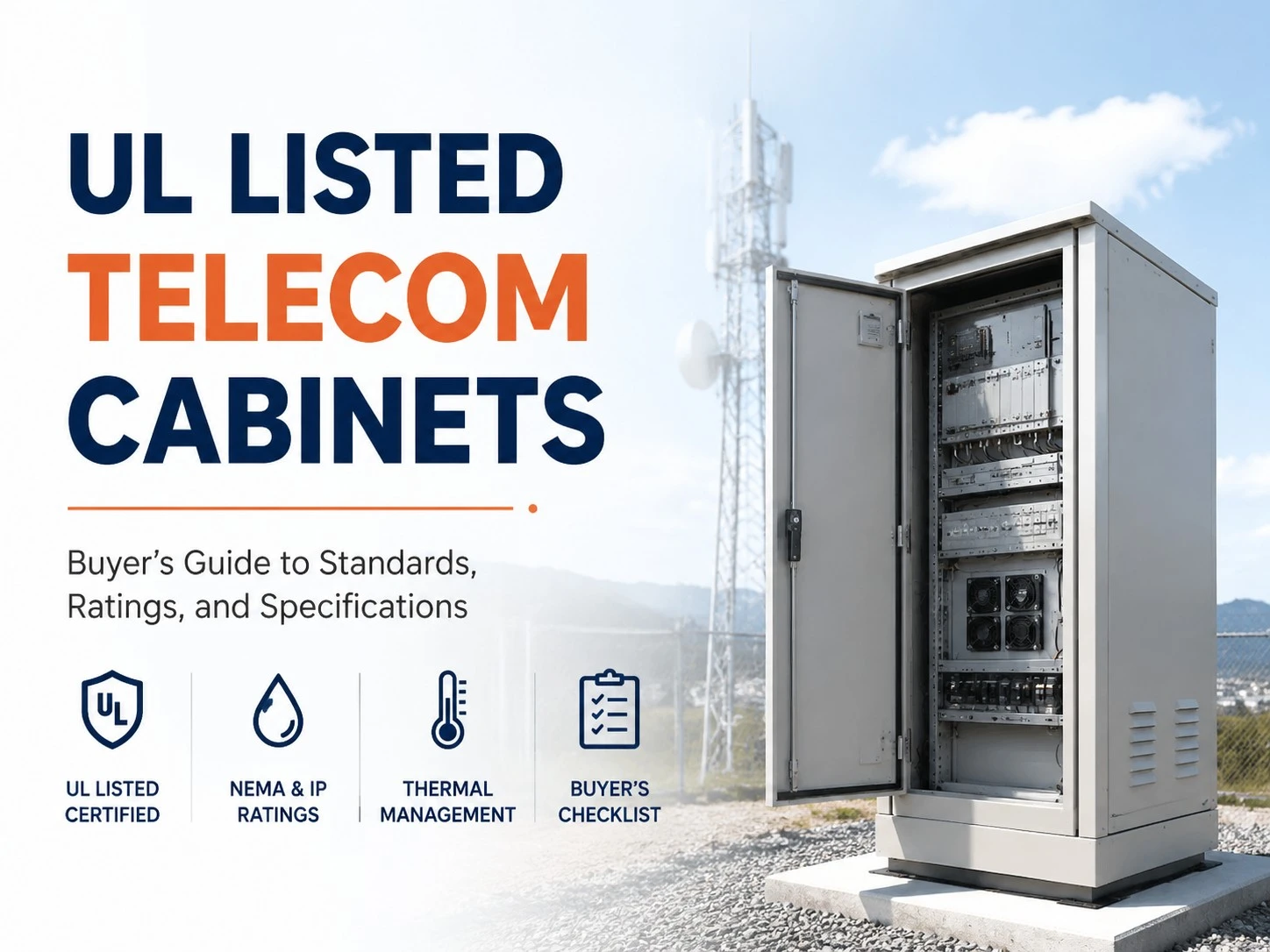
For a finished telecom cabinet, a UL Listing or other applicable UL product certification means the product has been evaluated to defined requirements within a specific certification scope.
That is different from UL Component Recognition. Recognized Components are intended for incorporation into larger end products and can be subject to defined Conditions of Acceptability. A cabinet may therefore contain UL Recognized fans, power supplies, breakers, fittings, or other parts without the complete cabinet assembly itself being UL Listed.
In practical terms, UL components do not automatically make a UL Listed telecom cabinet. Buyers who need a deeper explanation of this distinction can review Eabel’s guide to UL-gelistete Gehäuse.
UL Solutions is also one of several Nationally Recognized Testing Laboratories recognized by OSHA. For OSHA requirements that call for NRTL approval, equipment must be certified by an NRTL for the applicable standard within that laboratory’s recognized scope. If a project specification specifically requires a UL Listed product, do not substitute another certification mark without project approval.
Buyer Note: Do not approve a cabinet from a UL logo on a brochure alone. Match the certification to the exact manufacturer, model, product category, rating, and configuration being purchased.
Which UL Requirements Apply to Telecom Cabinets?
There is no universal “UL telecom cabinet standard.” The applicable requirement depends on what the product is and what functions are integrated into it.
| Product or Configuration | Relevant UL Requirement | Main Relevance |
|---|---|---|
| General electrical enclosure | UL 50 / UL 50E | Enclosure construction and environmental Type requirements |
| ICT cabinet, enclosure, or rack system | UL 2416 | Cabinet, enclosure, and rack systems for AV/ICT equipment |
| Active telecom or network equipment | UL/CSA 62368-1 | Safety of AV and information/communication technology equipment |
| Assembly functioning as an industrial control panel | UL 508A | Industrial control panel construction |
| Communications power distribution center | UL 1801 Outline of Investigation | Certain integrated power distribution systems for ICT equipment |
UL 50 und UL 50E
UL 50 addresses general enclosure requirements, while UL 50E covers additional environmental construction and performance requirements for electrical equipment enclosures used in non-hazardous locations. UL 50E includes indoor and indoor/outdoor enclosure Types and is intended to be used with UL 50 or applicable end-use product standards. Its latest revision is dated October 17, 2025.
For buyers, UL 50/50E should not be treated as a universal finished-cabinet certification. They address the enclosure itself, while an applicable end-use standard may impose additional requirements on the completed equipment. UL 50E itself states that where an individual product standard differs from its requirements, the individual product standard takes precedence. UL Solutions provides additional information on electrical enclosure certification and environmental ratings.
UL 2416
UL 2416 is especially relevant when the product is an ICT cabinet, enclosure, or rack system rather than a general electrical box.
Its scope directly covers Audio/Video, Information and Communication Technology Equipment Cabinet, Enclosure and Rack Systems. The standard was revised on November 7, 2025. It also makes clear that the Authority Having Jurisdiction ultimately determines whether the final installed configuration meets the necessary installation criteria.
For rack-style telecom infrastructure, UL 2416 can therefore be a more direct reference than evaluating the product only as a generic electrical enclosure. Buyers comparing physical rack formats and equipment layouts can also review this rack mount enclosure selection guide.
UL/CSA 62368-1
UL/CSA 62368-1 applies primarily to electrical and electronic equipment in the fields of audio, video, information, and communication technology. Its fourth edition was published in July 2025.
It can also include certain outdoor equipment and outdoor enclosures supplied specifically for housing equipment within its scope. That does not mean every telecom enclosure should automatically be specified to UL 62368-1. The complete product configuration and intended use determine whether the standard is applicable.
UL 508A
UL 508A covers industrial control panels and was revised in June 2025. Its scope includes assemblies of power or control circuit components with associated wiring and terminals.
It becomes relevant when the completed telecom assembly actually functions as an industrial control panel. The presence of a breaker, relay, terminal, or monitoring device by itself is not enough to conclude that UL 508A is the correct certification path.

UL 1801
UL 1801 is an Outline of Investigation for Power Distribution Centers for Communications Equipment, not a general telecom enclosure standard.
It addresses certain power distribution centers for ICT installations rated up to 600 V. These systems can include distribution equipment, overcurrent protection, controls, monitoring hardware, rectifiers, converters, inverters, batteries, racks, and enclosures.
UL 1801 may therefore matter for an integrated telecom power-distribution cabinet, but it should not be applied automatically to every cabinet containing a DC power supply.
The better purchasing question is not simply: “Is this cabinet UL Listed?”
It is: “What exactly is certified, under which requirement, and in what configuration?”
UL Type, NEMA, IP, and GR-487 Are Not the Same
UL product certification, enclosure Type ratings, IP classifications, and telecom-specific requirements can all appear in one project specification, but they answer different questions.
| Framework | Hauptzweck | What the Buyer Should Confirm |
|---|---|---|
| UL product certification | Evaluation of a defined product to applicable requirements | Is the exact product certified? |
| UL Type rating / NEMA enclosure Type | Environmental enclosure performance | Does the enclosure suit the site exposure? |
| IP-Bewertung | Protection against solid-object and water ingress | What ingress protection has been evaluated? |
| Telcordia GR-487 | Outside-plant telecom cabinet criteria | Does the project require telecom-specific OSP performance? |
NEMA publishes enclosure Type definitions and standards, but NEMA itself does not certify, test, or inspect individual products. Certification bodies can evaluate products against applicable enclosure requirements.
NEMA 3R, 4, and 4X
Type 3R, Type 4, and Type 4X are common considerations for outdoor electrical enclosures.
Type 3R provides a degree of protection for outdoor conditions including rain and sleet. Type 4 addresses more demanding exposure including windblown dust, splashing water, and hose-directed water. Type 4X adds a degree of protection against corrosion to the Type 4 characteristics.
That does not mean every outdoor telecom cabinet should automatically be Type 4X. The correct enclosure Type should follow the site’s actual exposure and the project specification.
IP Ratings Are Not Direct NEMA Equivalents
IP ratings and NEMA/UL Type ratings are not direct substitutes.
The IP system focuses on degrees of protection against access, solid objects, dust, and water. NEMA and UL Type designations consider a different set of enclosure characteristics.
For this reason, a statement such as “IP66 equals NEMA 4X” should be avoided unless the product has separately documented ratings supporting both designations. Buyers who need a deeper comparison can review NEMA- vs. IP-Gehäuseschutzarten.

Where GR-487 Fits
Telcordia GR-487 is aimed at electronic equipment cabinets deployed in outside-plant environments, including wireless applications. The current Issue 6, dated December 2022, covers functional design criteria, mechanical and environmental requirements, desired features, and performance testing for telecom cabinets.
Although it predates 2024, Issue 6 remains the current listed version and is still relevant where carrier or project specifications require telecom-specific OSP performance.
GR-487 does not replace a UL product certification or enclosure Type rating. It addresses another layer of outside-plant telecom performance.
A High Type Rating Does Not Solve Condensation
A stronger enclosure Type does not solve every environmental problem.
UL 50E does not cover protection of devices against condensation, icing, corrosion, or contamination that occurs within the enclosure or enters through conduit or unsealed openings. This does not conflict with the corrosion-resistance requirements associated with Type 4X; the requirements address different exposure conditions.
An outdoor telecom cabinet can still develop damaging internal conditions from equipment heat, solar gain, humidity, and daily temperature cycling.
Ingress protection and internal climate management therefore need to be specified separately.
How to Specify a Telecom Electrical Cabinet
Once the certification path is understood, cabinet selection should start with the real installation rather than a convenient catalog model.
Define the Deployment Environment
First determine whether the cabinet will operate indoors, in a sheltered outdoor location, or fully exposed outdoors.
Document the expected temperature range, rain, dust, humidity, salt exposure, corrosive contaminants, and direct sunlight. A cabinet installed in a controlled network room has a very different risk profile from one serving a coastal fiber network or exposed wireless site.
Select the required enclosure Type from those actual conditions instead of assuming the highest available rating is automatically the best specification.
List the Equipment Before Choosing Cabinet Size
The equipment list should drive the layout.
A telecom electrical cabinet can contain network switches, routers, fiber hardware, OLT equipment, radios, monitoring devices, power supplies, rectifiers, DC distribution hardware, or backup-power components.
Cabinet sizing should account not only for equipment dimensions but also for 19- or 23-inch rack compatibility where required, equipment depth and load capacity, cable routing, fiber bend radius, airflow, maintenance access, and realistic expansion.
An enclosure that physically fits every device but leaves technicians unable to reach connections or replace equipment is undersized in practice.
For projects that need a configurable platform rather than a fixed cabinet layout, Eabel’s electrical enclosure range includes wall-mount, free-standing, modular, server rack, and outdoor options that can be selected around equipment layout, access, and environmental requirements.

Define the Power Architecture
A passive fiber enclosure and an integrated telecom power cabinet require very different designs.
Document the incoming power, internal AC or DC distribution, rectifiers, overcurrent protection, monitoring, UPS functions, and batteries where applicable.
This information affects conductor routing, grounding and bonding, heat generation, component selection, and certification scope.
For systems with substantial communications power distribution, confirm the applicable end-product requirements rather than assuming the certification of the outer enclosure covers the complete electrical assembly.
If stationary batteries are integrated into the cabinet, verify the applicable battery or energy-storage requirements separately as well; enclosure certification alone does not establish compliance for the battery subsystem.
Size Cooling from the Heat Load
Cooling should be selected from equipment heat dissipation and site conditions, not cabinet dimensions alone.
The thermal design should account for total internal heat load, maximum ambient temperature, solar exposure, allowable internal temperature, and any required cooling redundancy.
Natural convection may be sufficient for some low-load applications. Filtered fans can handle higher heat loads but introduce outside air, increasing the importance of dust, humidity, filtration, and maintenance. Closed-loop heat exchangers or enclosure air conditioners can be more appropriate where internal equipment needs to remain isolated from dirty, humid, or corrosive outside air. Where several approaches are feasible, comparing active and passive enclosure cooling can help determine which method better fits the site.
The practical rule is simple: Calculate the thermal requirement first; select the cooling hardware second.
Match the Material to the Site
Material choice should reflect exposure, mechanical requirements, weight, cost, and expected service life.
Powder-coated steel suits many general telecom and industrial applications. Aluminum reduces weight and offers useful corrosion resistance in many outdoor installations. Stainless steel is often considered where corrosion exposure is especially demanding.
Material alone does not determine durability. Coatings, welds, fasteners, gaskets, hinges, penetrations, and installation quality all influence long-term enclosure performance.
Plan Cable Entry, Grounding, and EMC Early
Cable entry should be engineered before production rather than improvised during installation.
Define cable and conduit entry locations, gland plates, sealing methods, fiber routing, bend space, and grounding and bonding points before the cabinet is manufactured.
Any penetration can affect environmental performance if the opening or accessory is unsuitable for the enclosure rating. UL offers certification for Type- and IP-rated enclosure accessories including window kits, hole plugs, filter fan kits, air conditioners, heat exchangers, and cable or pipe sealing devices.
Where electromagnetic compatibility is important, enclosure construction, bonding, cable entry, internal layout, and installed equipment should be considered together. A metal enclosure by itself is not a complete EMC strategy.
Outdoor telecom sites may also require a separate lightning and surge protection strategy. UL/CSA 62368-1 does not cover protection against the effects of direct lightning strikes. For carrier or NEBS-oriented projects, requirements such as Telcordia GR-1089 may also address lightning, power faults, ESD, EMI, grounding, and related electrical stresses. Grounding, bonding, surge protection, and site-level lightning protection should therefore be reviewed against the actual installation requirements.
Design for Maintenance, Security, and Expansion
A telecom cabinet must remain practical to service throughout its operating life.
Technicians should be able to reach terminals, protection devices, filters, fans, fiber connections, and replaceable electronics without dismantling unrelated equipment. Outdoor or publicly accessible cabinets may also require stronger locks, protected hinges, vandal-resistant hardware, or controlled service access.
Leave enough rack space, cable capacity, power capacity, and thermal headroom for realistic expansion without automatically oversizing the enclosure.
Different applications shift these priorities. Indoor network cabinets place more emphasis on rack compatibility and service access. Outdoor fiber nodes place greater weight on sealing and climate control. Coastal installations make corrosion resistance more important, while integrated DC power cabinets require closer attention to electrical architecture, heat, and certification scope. For wireless projects, the impact of 5G deployment on telecom enclosure design also highlights the growing importance of thermal management, equipment density, power integration, and modularity.
Purchase price should therefore be only one part of the decision. Cooling energy, filters, fans, seals, corrosion maintenance, spare parts, technician time, and downtime all contribute to lifecycle cost.
A cabinet that costs slightly less to purchase but is difficult to maintain can become the more expensive option in service.

How to Verify a UL Listed Telecom Cabinet Before Ordering
Certification should be checked before the purchase order rather than after equipment reaches the installation site.
A valid product certification does not by itself establish compliance for the complete installation. Site wiring, grounding, overcurrent protection, clearances, and other installation details must still meet the applicable electrical codes and project requirements, with final acceptance subject to the Authority Having Jurisdiction where required.
A practical verification process is:
- Confirm the exact manufacturer and model. Match the quotation to the certification record rather than assuming every cabinet in the same product family carries identical certifications or ratings.
- Request traceable certification information. UL-Produkt-iQ supports searches using information including file numbers, Category Control Numbers, model information, and other identifiers.
- Confirm what was certified. Determine whether the certification applies to an enclosure, ICT rack or cabinet, industrial control panel, communications power product, or individual component.
- Confirm the applicable requirement and environmental rating. Match the certification record against the RFQ instead of accepting broad terms such as “weatherproof” or “outdoor rated.”
- Verify the final configuration. Confirm that doors, panels, windows, gland plates, cable fittings, cooling equipment, and other supplied options are consistent with the evaluated construction.
Put Certification Requirements Into the RFQ
Instead of asking only, “Is this cabinet UL Listed?”, make certification a defined procurement requirement.
The RFQ should identify the required certification, product category or applicable requirement where known, environmental Type, and any project-specific constraints. It should also require the supplier to provide the exact quoted model, traceable certification information, and confirmation that major accessories or custom configurations are covered.
This turns certification into something the buyer can verify rather than a marketing claim.
Descriptions such as “UL-ready,” “designed to UL standards,” or “built with UL components” may provide useful information, but none replaces verification of the finished product actually being purchased.
Check Customization Before It Changes the Compliance Picture
Telecom projects often require custom penetrations, cable glands, windows, cooling hardware, mounting systems, or internal electrical changes. Do not assume the original certification automatically covers those changes.
UL Solutions states that field evaluation is used to assess new, unlabeled, or modified equipment and notes that customized or modified equipment may require evaluation against applicable safety standards. An AHJ may require that evaluation before the equipment is energized.
Major modifications are therefore best defined before manufacturing and checked against the certified construction.
If field changes are unavoidable, document them and confirm their effect on sealing, bonding, wiring, spacing, thermal performance, and certification with the manufacturer, certification body, or Authority Having Jurisdiction as appropriate.

FAQs About UL Listed Electrical Cabinets for Telecom
Abschluss

Selecting UL Listed electrical cabinets for telecom infrastructure starts with identifying what the product actually is and which certification requirements apply. From there, match the enclosure to the site environment, equipment layout, rack format and load, power architecture, thermal load, cable entry, maintenance needs, and required environmental rating.
Most importantly, verify the product that will actually be delivered. The model, certification scope, Type rating, accessories, and customized configuration should agree with the project specification before the purchase order is issued.
If you are sourcing cabinets for 5G, fiber, broadband, outdoor telecom, or network infrastructure, send us your installation environment, cabinet dimensions, equipment list, power architecture, estimated heat load, UL and Type requirements, and required customizations. Kontaktiere uns to review your telecom cabinet specification and discuss a suitable UL Listed enclosure solution for your project.
Verwandte Lektüre
Kaufratgeber für Telekommunikationsgehäuse für den Außenbereich
Leitfaden zur Temperaturregelung von Schaltschränken
So verhindern Sie Kondensation in Gehäusen
NEMA 3R vs. NEMA 4X: Welches ist das beste?
Belüftungsöffnungen in elektrischen Gehäusen: Zweck, Typen und Auswahlhilfe



 DE
DE  EN
EN  ES
ES  FR
FR  AR
AR  JA
JA  KO
KO  RU
RU  PT
PT  IT
IT  ZH
ZH  TH
TH  VI
VI  HI
HI  MS
MS 