

When a 100% Rating Adds Real Project Value
When It Avoids Larger Equipment
Evaluate a 100% option when standard continuous-load sizing pushes the project to a higher breaker ampere rating. Potential benefits include retaining a smaller frame, reducing conductor requirements where permitted, or avoiding a larger switchboard section.
Distinguish the calculated minimum, the selected ampere rating, and the physical equipment size. These are separate decisions. If the frame size and enclosure dimensions stay the same, a lower ampere rating alone does not save cabinet space.
When Capacity or Equipment Requirements Matter
A 100% configuration can also be valuable when the present breaker sizes match but future loads are planned. Calculate both the current and expanded load before selecting equipment, and state any required design reserve explicitly.
Equipment instructions are another reason to select a particular configuration. For example, some UPS installation guides identify their recommended upstream breakers as 100%-rated. Have the designer review a proposed alternative against the equipment instructions; matching ampere ratings alone do not establish equivalence.
When the Standard-Rated Option Fits Better
Keep the standard-rated option when it meets the present and planned loads and the alternative adds no useful project benefit. The presence of long-running equipment is not, by itself, a reason to change the specification.
Compare current quotes for complete, compliant configurations, including enclosures, conductors, connection hardware, and installation work. Check delivery schedules separately; the lowest breaker price does not necessarily mean the lowest installed cost.

How 80% and 100% Ratings Affect Load Sizing
Understand the Continuous-Load Distinction
For these NEC rules, a load is continuous when its maximum current is expected to last at least three hours. A machine running all day is not automatically a continuous load at its full nameplate current. Establish the design load from the applicable rules and operating profile.
A standard-rated breaker is often called an 80%-rated breaker. For continuous-only loading, its application limit is 80% of the applicable current rating. A 100%-rated breaker permits continuous loading up to its applicable rating under its listed installation conditions. Qualifying noncontinuous loads can use a standard breaker’s full rating, subject to other circuit requirements.
Neither percentage is a trip threshold. Corresponding standard and 100% versions can have the same trip curve, so changing the rating is not a general cure for nuisance trips.
Apply the Factor Only to the Continuous Portion
For general branch-circuit and feeder overcurrent sizing, let C be the continuous load and N the noncontinuous load:
- Standard-rated design: minimum breaker rating = N + 1.25C.
- Design qualifying for the 100% assembly exception: minimum breaker rating = N + C.
In the 2023 NEC, use 210.20(A) for branch circuits and 215.3 for feeders. Under the 2026 NEC feeder rules, overcurrent protection is addressed in 215.5. Apply the locally adopted edition and equipment-specific rules; the 100% allowance requires the assembly, including its protective device, to be listed for 100% operation.
Compare Current Selection and Planned Growth
The examples assume the indicated breaker ratings and compliant configurations are available. The final row adds planned continuous load to Case B.
| Load scenario | Standard-rated design | Qualifying 100% design |
|---|---|---|
| A: 320 A continuous + 80 A noncontinuous | 480 A minimum; select 500 A | 400 A minimum; select 400 A |
| B, present: 80 A continuous + 300 A noncontinuous | 400 A minimum; select 400 A | 380 A minimum; select 400 A |
| B, planned: 100 A continuous + 300 A noncontinuous | 425 A minimum; a 400 A breaker is insufficient | 400 A minimum; retain 400 A with the added 20 A continuous load |
The planned-growth result assumes that conductors, bus, terminals, and the rest of the system also support the added load. These calculations do not establish wire sizes or approve changes to an existing panel.

What to Verify Before Specifying or Replacing a Breaker
Confirm the Exact Breaker and Listed Configuration
Obtain the complete catalog number and the manufacturer’s documentation for 100% continuous application. A product family offering a 100% option does not establish that every version has it. Check the actual device marking and any required model suffix against the current documentation.
Confirm the permitted assembly configuration through its listing and installation instructions. For UL-listed enclosures, verify the certification’s scope: enclosure certification alone does not establish 100% suitability for the completed assembly. Enclosures do not always carry a separate 80% or 100% label.
Check voltage and poles against the system, and verify the breaker’s interrupting rating and the assembly’s short-circuit current rating (SCCR) against the available fault current. A higher breaker interrupting rating does not, by itself, raise the assembly rating. The 100% designation does not establish fault-duty suitability.
Check the Enclosure and Existing Equipment
The enclosure must dissipate heat under the tested conditions. Match the manufacturer’s minimum enclosure dimensions, ventilation, mounting arrangement, and operating conditions. Some 100% configurations need more enclosure space or ventilation than a standard version at a comparable rating. Check the air temperature around the breaker inside the enclosure and apply any required temperature or altitude derating. A 100% rating does not override these operating limits.
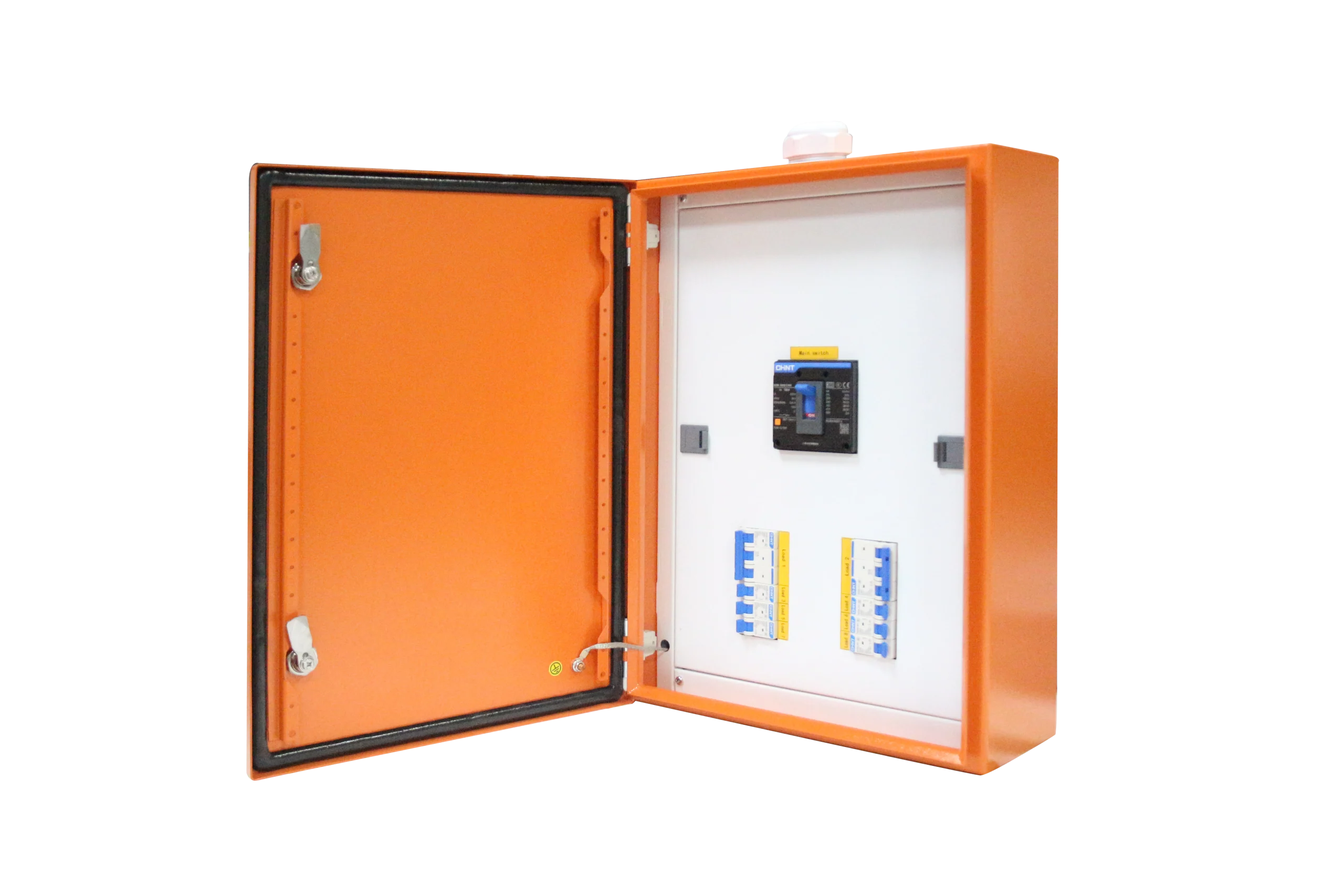
For new assemblies, E-abel’s enclosure range includes wall-mounted, free-standing, and modular options. Use the documented breaker requirements to narrow the cabinet choice before comparing price and delivery.
For a panelboard retrofit, check the permitted breakers and installation markings and ask the equipment manufacturer to confirm the proposed configuration before ordering a replacement. Matching dimensions and ampere markings do not prove that the existing bus, mounting, terminals, and enclosure support the new application. Installing a 100%-rated main breaker does not automatically make every circuit in the panel suitable for 100% continuous loading.

Verify Conductors and Terminations
Determine conductor ampacity under the applicable sizing rules, including any permitted continuous-load exception. Then check temperature correction and conductor-count adjustments, along with overcurrent protection. A 100% breaker rating alone does not authorize a smaller wire.
Some 100%-rated installations require 90°C-insulated conductors sized using 75°C ampacity. The higher insulation rating does not authorize the use of 90°C ampacity at the terminals. Follow the equipment’s wire and connector requirements.
Where permitted, start correction and adjustment calculations with 90°C ampacity. Use the lower of the calculated result and the ampacity allowed by the equipment’s termination rating. Check both ends of the conductor; a 90°C lug marking does not override a lower equipment temperature rating.
Check the Applicable Rating and Trip Setting
For an adjustable breaker, distinguish the frame rating from the current rating or setting that governs the application. A larger frame is not permission to base the continuous-load calculation on that larger number.
For example, a standard-rated 600 A PowerPacT L-frame breaker set at 400 A does not become 100%-rated because the setting is below the frame maximum. For continuous-only loading, the manufacturer’s stated limit is 320 A at that setting.
When the selected breaker or its settings change, review coordination with upstream and downstream protective devices. For loads with startup or energizing surges, also verify that the breaker can pass those brief currents without unwanted trips.
Put the Evidence in the Specification
State the submittal requirements so each proposed breaker can be checked against the same design basis. A concise specification clause can read:
Provide a 100%-rated MCCB in a configuration permitted for the stated circuit and load profile. Submit the exact model and manufacturer documentation demonstrating that the complete installation meets the applicable 100% conditions. Identify required installation provisions and any departures from the specified design. Submit proposed substitutions for review before procurement.
Have the project designer review the submittal against the adopted NEC edition, local amendments, and equipment instructions.

FAQs About 100%-Rated Circuit Breakers
Conclusion
A 100%-rated circuit breaker is justified when it meets specific capacity or equipment requirements and the complete installation qualifies for that use. Its value comes from the actual equipment selected and the loads it must serve, including planned growth. Where the standard design already meets those needs, it remains a sound choice.
Before ordering, bring the comparison down to a specific breaker and compatible equipment configuration. A load schedule, expected operating hours, planned additions, and panel or switchboard details make the inquiry more useful; include a single-line diagram if available. That gives the discussion a clear basis for model selection and pricing. Contact us to discuss your enclosure and assembly requirements and request a quote for your project.
Related Reading
How to Size a Panelboard Correctly: Step-by-Step
UL 508A vs UL 67 vs UL 891: Key Differences
Electrical Enclosure Temperature Control Guide



 EN
 ES
 FR
 AR
 JA
 KO
 RU
 DE
 PT
 IT
 ZH
 TH
 VI
 HI
 MS
